



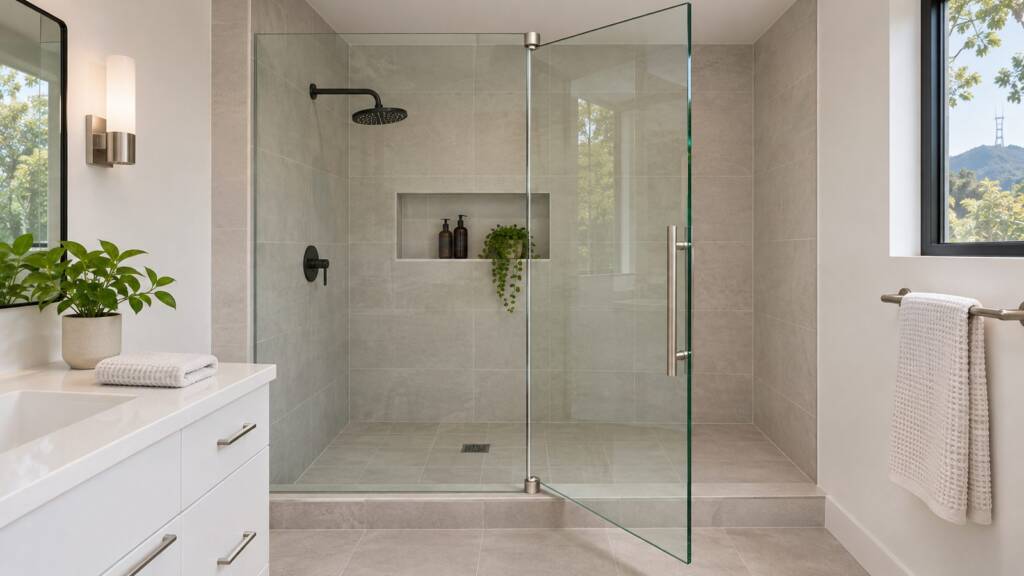
Types of shower doors fall into three main groups by how they open: hinged doors that swing on side hinges, pivot doors that turn on top and bottom pivots, and sliding doors that glide along a track. Hinged and pivot doors need clear floor space to swing open, while sliding doors need none, which makes them the usual choice for bathtubs and small bathrooms.
How a door opens matters as much as how it looks. It decides how much floor space the door takes, how wide the entry is, how well it keeps water in, and how easy it is to clean.
This guide compares the types of shower doors side by side, explains the difference between pivot and hinged doors, and shows which type suits which bathroom layout. It is written by the Insight Glass team, licensed California contractors (CSLB 599566) installing shower doors across the Bay Area since 1987.
What Are the Main Types of Shower Doors?
The main types of shower doors are hinged, pivot and sliding (bypass) doors, with bi-fold doors and corner enclosures as less common options. Each can be framed, semi-frameless or frameless, so the opening style and the frame style are two separate choices.
| Door type | How it opens | Floor space needed | Typical opening | Best for |
|---|---|---|---|---|
| Hinged | Swings outward on hinges fixed to the wall or a glass panel | About the width of the door | Door 22 to 36 inches, often with a fixed panel | Walk-in showers, frameless remodels |
| Pivot | Turns on pivots at the top and bottom of the door | About 24 to 30 inches | Door 24 to 36 inches | Wide entries, walls without solid backing |
| Sliding (bypass) | Two panels slide past each other on a track | None | 48 to 72 inch opening | Bathtubs, alcove showers, small bathrooms |
| Bi-fold | Folds in the middle as it opens | About half the door width | Narrow openings | Very tight stalls |
| Corner (neo-angle) | Hinged or pivot door set in an angled or corner enclosure | Depends on the door | 32 x 32 to 42 x 42 inch base | Corner showers in compact bathrooms |
What Is a Hinged Shower Door?
A hinged shower door swings open on hinges mounted on its side, fixed either to the wall or to a fixed glass panel. It opens like a room door and must swing outward, away from the shower, under California plumbing code.
Hinged doors are the standard choice for frameless showers. Glass-to-wall hinges suit a single door in a stall, and glass-to-glass hinges let a door hang from a fixed panel across a wider opening. The result is a wide, clear entry with very little metal.
The trade-offs are swing space and wall backing. You need open floor in front of the door about as wide as the door itself, and the wall behind the hinges needs solid backing to carry heavy glass. Insight Glass installs hinged doors as part of its frameless shower doors work across the Bay Area.
What Is a Pivot Shower Door?
A pivot shower door turns on pivot hardware set at the top and bottom of the door, instead of hinges on its side. The pivot point can sit near the edge of the door or farther in, and many pivot doors can swing both inward and outward.
Because the weight sits on the top and bottom pivots rather than the wall, pivot doors suit wider or heavier doors and walls where solid backing is hard to reach. Pivots set in from the edge also shorten the swing, so the door needs a little less floor space than a hinged door of the same width.
Pivot doors typically use 3/8 to 1/2 inch tempered glass and need about 24 to 30 inches of clear floor space to open fully. See our pivot shower doors page for configurations.
What Is the Difference Between Pivot and Hinged Shower Doors?
The difference between pivot and hinged shower doors is where the door turns. A hinged door turns on hinges along its side and swings one way, while a pivot door turns on pins at the top and bottom and can often swing both ways.
| Feature | Hinged | Pivot |
|---|---|---|
| Where it turns | Hinges on the side of the door | Pivots at the top and bottom |
| Swing direction | Outward only | Outward, and often inward too |
| Weight carried by | The wall or a fixed glass panel | The header and the floor or curb |
| Wall backing | Needs solid backing at the hinges | Less dependent on wall backing |
| Look | Very minimal on frameless doors | Clean, with small pivot fittings |
| Best for | Frameless stalls and door-plus-panel showers | Wider doors, out-of-plumb walls, tight swing space |
For most frameless remodels, a hinged door is the default. A pivot door is the better fit when the wall cannot carry hinges, when the door is wide and heavy, or when a two-way swing helps in a tight layout.
What Is a Sliding Shower Door?
A sliding shower door, also called a bypass door, has two or more glass panels that slide past each other on a track. It opens without swinging, so it needs no clear floor space in front of the shower.
Sliding doors cover openings from about 48 to 72 inches wide and are the most common door on bathtubs. They come framed, with full channels around the glass, or semi-frameless, with a slim track and minimal framing. The track keeps water in well, but it needs regular cleaning to stop soap and mineral buildup.
The main limit is the entry width. Because the panels overlap, you can only open about half of the total width at a time.
Should You Choose a Sliding or Hinged Shower Door?
Choose a sliding shower door if the bathroom is small, the door sits on a bathtub, or there is no floor space for a swing. Choose a hinged door if you want the widest entry, the cleanest frameless look and the easiest glass to clean.
- Space: sliding doors need no swing space; hinged doors need floor space about as wide as the door.
- Entry width: hinged doors open the full door width; sliding doors open about half the total width.
- Cleaning: hinged frameless doors have no track; sliding doors have a track to keep clean.
- Bathtubs: sliding doors are the common choice; a hinged door on a tub ledge is possible but less practical.
- Cost: framed sliding doors run $800 to $1,500 installed in the Bay Area, while frameless hinged doors run $2,000 to $3,500.
In many Bay Area homes, the deciding factor is the toilet or vanity. If a hinged door would hit either when it opens, a sliding door or a pivot door with a shorter swing is the practical choice.
What Are Bi-Fold and Corner Shower Doors?
A bi-fold shower door folds in the middle as it opens, so it needs about half the floor space of a hinged door of the same width. It suits very narrow stalls where neither a full swing nor a sliding door fits.
Corner and neo-angle enclosures are layouts rather than door types. They place a hinged or pivot door on the front or angled face of a corner shower, with fixed glass panels on the sides, and are common in compact San Francisco and Oakland bathrooms.
Which Type of Shower Door Fits Your Bathroom?
The right type of shower door depends on the floor space in front of the shower, the width of the opening, and whether it sits on a tub or a curb. Start with the space, then choose the look.
- Small bathroom with little floor space: sliding, or a pivot door with a short swing.
- Bathtub: sliding bypass doors, or a single fixed panel.
- Walk-in shower with a curb: a frameless hinged door with a fixed panel.
- Wide or heavy door, or walls without solid backing: pivot.
- Corner shower: a neo-angle enclosure with a hinged or pivot door.
- Very narrow stall: bi-fold.
Insight Glass measures each bathroom on site and recommends the door type that fits the space, from Benicia and Vallejo to Walnut Creek, Oakland, San Francisco and San Jose.
Frequently Asked Questions
What are the different types of shower doors?
The main types of shower doors are hinged, pivot and sliding (bypass) doors. Bi-fold doors and corner or neo-angle enclosures are less common options. Each type can be framed, semi-frameless or frameless.
What is the difference between a pivot and a hinged shower door?
A hinged door turns on hinges along its side and swings outward. A pivot door turns on pins at the top and bottom and can often swing both ways. Pivot doors suit wider doors and walls without solid backing; hinged doors suit most frameless showers.
Which type of shower door is best for a small bathroom?
A sliding door is usually best for a small bathroom because it needs no floor space to open. If you want a swinging door, a pivot door with pivots set in from the edge has a shorter swing than a hinged door.
Are sliding or hinged shower doors better?
Neither is better in every bathroom. Sliding doors save space and suit bathtubs. Hinged doors give a wider entry, a cleaner frameless look and easier cleaning because there is no track.
Which way should a shower door open?
A hinged shower door must open outward, away from the shower, under California plumbing code. Many pivot doors can swing both ways, which can help in tight layouts.
How much floor space does a pivot shower door need?
A pivot shower door typically needs about 24 to 30 inches of clear floor space to open fully without hitting a toilet, vanity or wall. Pivots set in from the edge of the door reduce the swing.
Choosing Between the Types of Shower Doors
Match the door type to your space first: sliding where there is no room to swing or the door sits on a tub, hinged for a wide frameless entry, and pivot for wide doors, weak wall backing or a shorter swing. Then pick framed, semi-frameless or frameless for the look and budget.
Insight Glass measures, supplies and installs hinged, pivot and sliding shower doors across the Bay Area. See our frameless shower doors page or call (707) 746-6571 for an in-home measurement and a written quote.
Prices reflect Insight Glass installed pricing for Bay Area projects as of October 2026. Door swing references are based on the California Plumbing Code. Confirm with your building department before ordering.
Disclaimer: The information provided in this article is for general informational purposes only and does not constitute professional or contractor advice. Sizes and clearances shown are typical ranges, and every shower should be field measured before glass is ordered. Price ranges are typical installed costs for the San Francisco Bay Area as of the “Updated” date shown at the top of this article and may change. Insight Glass Inc is a licensed California contractor (License #599566). Contact us for a written quote on your shower door project.

