California pool fence requirements call for a barrier at least 60 inches high, no more than 2 inches of clearance at the bottom, no openings larger than 4 inches, and gates that open away from the pool and close and latch on their own. A glass pool fence meets these rules when the panels are tempered safety glass and the gaps, gate and latch are set to the code limits.
These rules come from the California Swimming Pool Safety Act, which applies when a new pool or spa is built or an existing one is remodeled under a building permit at a private home. California sets a taller barrier than the national model code, so a fence built to a generic guide can fail a Bay Area inspection.
This guide covers each California pool fence requirement, how glass pool fencing meets it, gate and latch rules, and what inspectors check. It is written by the Insight Glass team, licensed California contractors (CSLB 599566) installing glass pool fencing across the Bay Area since 1987.
What Are the California Pool Fence Requirements?
California pool fence requirements set the height, gaps, climbability and gate hardware of a barrier around a home pool or spa. The key numbers are a 60 inch minimum height, a 2 inch maximum gap at the bottom, and no opening larger than 4 inches anywhere in the fence.
| Requirement | California rule | What it means for a glass fence |
|---|---|---|
| Height | At least 60 inches, measured on the outside of the fence | Panels and spigots set so the top of the glass is 60 inches or more above the ground outside |
| Bottom gap | No more than 2 inches between the bottom of the fence and the ground | Spigot and base shoe heights kept within the limit on every panel |
| Openings | No opening, hole or gap that allows a 4 inch sphere to pass | Gaps between panels and at posts kept under 4 inches |
| Climbability | No handholds or footholds on the outside surface | Smooth glass with no rails or ledges a child could climb |
| Gates | Open away from the pool, self-closing and self-latching | Glass gate on self-closing hinges with a latch release at 60 inches or higher |
| Glass | Safety glazing where glass is near a pool | Tempered or laminated glass in every panel |
California is stricter than the national model code. Many national guides list a 48 inch pool barrier, but the California Swimming Pool Safety Act requires 60 inches for an enclosure around a home pool.
When Do California Pool Fence Requirements Apply?
California pool fence requirements apply when a building permit is issued for a new pool or spa at a private single-family home, and when an existing pool or spa is remodeled under a permit. Local building departments enforce them as part of the pool permit.
The state law does not by itself require an older pool with no permit work to be brought up to date. Some Bay Area cities and HOAs set their own rules, and home sales often bring a barrier inspection, so check local requirements even if you are not building a new pool.
Pools at apartments, HOAs, hotels and other shared properties fall under the public pool rules in the California Building Code, which have their own barrier requirements.
What Is the Two Safety Features Rule for California Pools?
Under the California Swimming Pool Safety Act, a new or remodeled pool or spa at a private home must have at least two of seven drowning prevention safety features. A compliant pool fence counts as one of them.
The seven safety features are:
- An enclosure that isolates the pool from the home, meeting the height, gap and gate rules above.
- Removable mesh fencing with a self-closing, self-latching gate.
- An approved safety pool cover.
- Exit alarms on doors that give direct access to the pool.
- A self-closing, self-latching device on doors that give direct access to the pool, with the release at least 54 inches above the floor.
- An alarm that sounds when someone goes into the water.
- Another means of protection that is equal to or greater than the features above.
A glass pool fence that isolates the pool from the house is the first feature. Most homeowners pair it with door alarms or self-closing door hardware on the doors leading to the pool.
How Does Glass Pool Fencing Meet California Requirements?
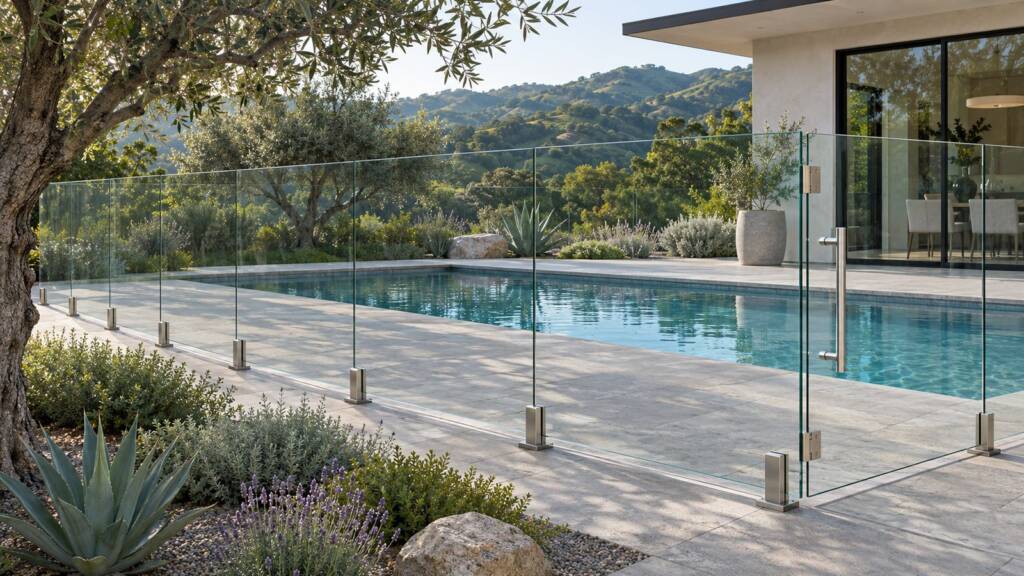
Glass pool fencing meets California requirements when it uses tempered or laminated safety glass, stands at least 60 inches high, keeps the bottom gap at 2 inches or less, and keeps every gap between panels under 4 inches. Smooth glass with no horizontal rails also meets the rule against handholds and footholds better than most other fence types.
The details that decide whether a glass fence passes:
- Safety glass: glass in a fence near a pool is a hazardous location under the California Building Code and Residential Code, so it must be safety glazing. Pool fence panels are typically 1/2 inch tempered glass.
- Panel height: the 60 inches is measured from the ground on the outside of the fence, so sloped yards need panels sized to the lowest point along the run.
- Bottom clearance: spigots lift the glass off the deck, so the spigot height and any slope in the paving have to keep the gap at 2 inches or less.
- Gaps between panels: the space between panels, and between a panel and a wall or post, has to stay under 4 inches.
- No climbing aids: keep planters, benches, pool equipment and walls that a child could climb away from the outside of the fence.
Insight Glass installs glass pool fencing in frameless and semi-frameless systems, with panel heights, gaps and gate hardware set to California limits.
What Are the Gate Requirements for a California Pool Fence?
A gate in a California pool fence must open away from the pool, close on its own, and latch on its own, with the latch release at least 60 inches above the ground. The gate is the part of a pool fence that fails inspection most often.
For a glass gate, that means:
- Swing direction: the gate opens outward, away from the pool, so a child pushing on it cannot open it into the pool area.
- Self-closing hinges: hinges rated for the weight of the glass that return the gate to closed from any open position.
- Self-latching latch: a latch that engages every time the gate closes, often a magnetic latch made for glass gates.
- Latch height: the release mechanism sits at 60 inches or higher, out of reach of young children.
Test the gate from several opening positions after installation. If it does not close and latch every time, it does not meet the requirement.
Frameless or Semi-Frameless Glass Pool Fencing?
Both frameless and semi-frameless glass pool fencing can meet California pool fence requirements. The choice comes down to look, budget and the deck or paving the fence sits on.
- Frameless: thick tempered panels on stainless spigots, with no posts or top rail. Gives the clearest view of the pool and suits new paving where spigots can be core-drilled.
- Semi-frameless: panels held by slim posts or clamps, often at a lower cost. Suits existing paving and long runs.
Near the coast and around pool chemicals, marine-grade 316 stainless hardware holds up best. The same glass and hardware choices apply to glass railings on decks and balconies above the pool.
Do You Need a Permit for a Glass Pool Fence in California?
A glass pool fence installed as part of a new or remodeled pool is reviewed under the pool permit, and the barrier is inspected before the pool is approved. A fence added on its own may also need a permit, depending on the city and its height and location.
Inspectors usually check the fence height from the outside, the bottom gap, the gaps between panels, the gate swing, the self-closing and self-latching function, the latch height, and the safety glass marking on the panels. Confirm requirements with your local building department before ordering, since Bay Area cities can add their own rules.
Frequently Asked Questions
How tall does a pool fence have to be in California?
A pool enclosure at a California home must be at least 60 inches high, measured on the outside of the fence. That is taller than the 48 inch barrier in many national guides, so build to the California figure.
Is a glass pool fence legal in California?
Yes. A glass pool fence is legal in California when it uses tempered or laminated safety glass, is at least 60 inches high, has no more than a 2 inch gap at the bottom, keeps all other gaps under 4 inches, and has a self-closing, self-latching gate.
What is the maximum gap at the bottom of a pool fence in California?
The gap between the bottom of a California pool fence and the ground can be no more than 2 inches. On a glass fence, spigot height and any slope in the paving have to be set so every panel stays within that limit.
Which way must a pool gate open in California?
A pool gate must open away from the pool, close on its own, and latch on its own. The latch release must be at least 60 inches above the ground so young children cannot reach it.
Does an existing pool need a fence in California?
The state pool safety law applies when a permit is issued for a new pool or for remodeling an existing one. Older pools with no permit work are not automatically required to add a fence, but local rules, HOAs and home sales can require one.
How many safety features does a California pool need?
A new or remodeled pool or spa at a private California home needs at least two of seven drowning prevention safety features. A compliant pool fence counts as one; door alarms, self-closing door hardware, a safety cover or a pool alarm can be the second.
Meeting California Pool Fence Requirements with Glass
Set the fence to the California numbers first: 60 inches high, 2 inches or less at the bottom, every gap under 4 inches, and a gate that opens away from the pool, closes and latches on its own. Then choose frameless or semi-frameless glass for the look and the paving, and pair the fence with a second safety feature on the doors to the pool.
Insight Glass designs and installs glass pool fencing across the Bay Area to California pool fence requirements. See our glass pool fencing page or call (707) 746-6571 for a site visit and a written quote.
Requirements are based on the California Swimming Pool Safety Act (Health and Safety Code Sections 115920 to 115929) and the California Building and Residential Codes as published in October 2026. Local amendments apply. Confirm with your building department before ordering.
Disclaimer: The information provided in this article is for general informational purposes only and does not constitute legal, professional, or contractor advice. Requirements reflect California law and code as published at the “Updated” date shown at the top of this article and are subject to amendment and local jurisdiction modifications. This article is not a compliance determination for any specific pool. Insight Glass Inc is a licensed California contractor (License #599566). Contact us for a written quote on your glass pool fence project.