Glass railing hardware is the set of fittings that holds the glass panels in place and carries the load into the deck, stair or balcony. The four main types are base shoe channels, spigots, standoffs and clamps with posts, and the one you choose decides how the railing looks, what glass it needs and what it costs.
Most people pick a railing by the look of the glass, but the hardware does the structural work. It has to hold the panels against a person leaning on them, wind on an upper floor, and seismic movement, while staying clean and corrosion-free for years.
This guide explains each type of glass railing hardware, where it mounts, the glass it takes, top rail options, finishes for Bay Area conditions, and how hardware changes the price. It is written by the Insight Glass team, licensed California contractors (CSLB 599566) installing glass railings across the Bay Area since 1987.
What Are the Main Types of Glass Railing Hardware?
The main types of glass railing hardware are base shoe channels, spigots, standoffs, and clamps used with posts. Base shoes, spigots and standoffs hold the glass without vertical posts for a frameless look, while clamps and posts share the load with a frame for a semi-frameless or post-supported railing at a lower price.
| Hardware | How it holds the glass | Where it mounts | Look | Railing type |
|---|---|---|---|---|
| Base shoe channel | Continuous metal channel gripping the bottom edge | Deck or floor surface, fascia, or recessed into a slab | Clean line, no posts | Frameless |
| Spigots | Short posts clamping each panel near the base | Deck or floor surface, or core-drilled into concrete | Panels appear to stand on their own | Frameless |
| Standoffs | Round pins bolted through holes in the glass | Fascia (the outside face of the deck or stair) | Glass appears to float off the edge | Frameless |
| Clamps with posts | Clamps hold panels between metal posts | Deck or floor surface, or fascia | Slim posts with glass between | Semi-frameless or post-supported |
What Is a Base Shoe for a Glass Railing?
A base shoe is a continuous aluminum channel that grips the bottom edge of the glass along the full length of the run. The glass stands in the channel with no posts, and the channel carries the load into the structure below.
Base shoes give the cleanest look of any glass railing hardware, with an unbroken line of glass and a single low profile at the bottom. They can mount on top of the deck or floor, on the fascia, or recessed into a concrete slab so the channel sits flush with the walking surface. A recessed base shoe usually suits new construction, because the surface has to be cut in.
Because all the force arrives at the base of the glass, base shoe systems ask the most of the structure and usually take thicker glass, often 1/2 inch or a laminated make-up. On a deck, the channel also has to be flashed so water does not get into the framing.
What Are Glass Railing Spigots?
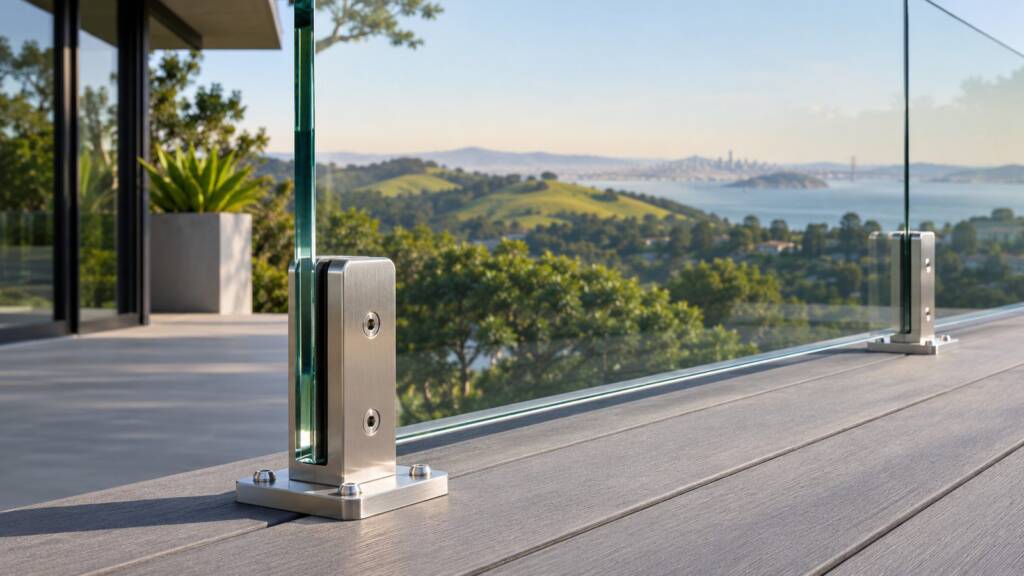
Glass railing spigots are short, round or square stainless posts, usually two per panel, that clamp the glass a few inches above the floor. They give a frameless look like a base shoe, with small gaps between panels and at the bottom.
Spigots are a common choice for pool fencing, patios and decks where a continuous channel would trap water or leaves. They mount on a base plate bolted to the deck or slab, or they are core-drilled and set directly into concrete for the cleanest finish.
Each spigot carries a concentrated load, so the deck framing or slab under each fitting has to be solid. Spigot systems typically use 1/2 inch tempered or laminated glass. Insight Glass installs spigot, base shoe and standoff systems as part of its frameless glass railings work across the Bay Area.
What Are Glass Standoffs?
Glass standoffs are round stainless fittings, usually two per panel, that bolt through holes drilled in the glass and attach it to the fascia of a deck, balcony or stair. The glass sits a short distance off the structure, so it appears to float along the edge.
Standoffs keep the full width of the deck or stair tread free, which makes them useful where space is tight. They are popular on stairs, where the glass follows the rake of the stringer, and on balconies where a surface-mounted system would take up floor space.
The holes are drilled before the glass is tempered, so every panel is made to measured dimensions. Standoff systems put the load directly into the edge structure, so the rim joist, stringer or slab edge has to be sound. See how standoffs work on a staircase on our glass stair railing page.
What Are Glass Railing Clamps and Post Systems?
Glass railing clamps hold each panel between metal posts, either on the sides of the posts or between them, so the posts and a top rail share the load with the glass. This is the hardware behind semi-frameless and post-supported glass railings.
Because the posts carry much of the load, clamp systems can use thinner glass, commonly 3/8 to 1/2 inch, and they ask less of the structure. That makes them the lowest-cost glass railing hardware and a practical choice for retrofits on existing decks.
The trade-off is the look. You see slim posts and clamps every few feet instead of an unbroken run of glass. For many decks, that is a fair trade for a lower price and a simpler install.
Does Glass Railing Hardware Need a Top Rail?
A glass railing does not always need a top rail, but the choice changes the glass. A guard with a continuous top rail can use monolithic tempered glass, because the rail holds the line if a panel ever breaks; a guard without one has to use laminated glass so the panel stays in place.
Top rail options include:
- Cap rail: a U-shaped channel that slips over the top edge of the glass and ties the panels together.
- Handrail on brackets: a round or square rail fixed to the glass or posts, required where the railing also serves as a stair handrail.
- No top rail: the most open look, using laminated glass and heavier base hardware.
California requires residential guards to reach 42 inches above the walking surface and to carry a 200 pound concentrated load at any point along the top, plus seismic loads. Stairs also need a graspable handrail. Confirm current requirements with your local building department, since the railing is reviewed during the permit.
What Materials and Finishes Are Used for Glass Railing Hardware?
Most glass railing hardware is stainless steel or aluminum, finished in brushed or polished stainless, or powder-coated black or another color. Near the water, marine-grade 316 stainless is the finish to specify, because standard 304 stainless can show surface rust in salt air.
| Material or finish | Where it suits | Notes |
|---|---|---|
| 316 stainless (marine grade) | Waterfront and coastal sites, pools | Best corrosion resistance for spigots, standoffs and clamps |
| 304 stainless | Interior stairs and inland decks | Lower cost; not recommended near salt water |
| Anodized or powder-coated aluminum | Base shoe channels, cap rails, posts | Light, holds its shape, wide color range |
| Black powder coat | Modern homes, contrast with light decking | Check the coating is rated for exterior use |
In Bay Area waterfront areas such as Sausalito, Tiburon, Alameda, Richmond and Benicia, rinse stainless hardware with fresh water a few times a year and avoid abrasive pads, which scratch the finish and give corrosion a place to start.
How Does Glass Railing Hardware Affect the Cost?
Hardware is one of the biggest factors in glass railing cost. In the Bay Area, frameless systems using base shoes, spigots or standoffs run $225 to $450 per linear foot installed, semi-frameless clamp systems run $125 to $250, and post-supported railings start at about $120 per linear foot.
| System | Hardware | Installed price per linear foot |
|---|---|---|
| Frameless | Base shoe, spigots or standoffs | $225 to $450 |
| Semi-frameless | Clamps with minimal framing | $125 to $250 |
| Post-supported | Posts, clamps and top rail | From about $120 |
What moves the price within each range:
- Glass make-up: laminated glass and thicker panels cost more than monolithic tempered.
- Finish: marine-grade stainless and custom powder coat colors cost more than standard finishes.
- Mounting: core drilling, recessed channels and fascia work take more labor than surface mounting.
- Structure: framing or slab edges that cannot carry the load need work before the railing goes on.
- Layout: stairs, corners and curves need more fittings and custom-cut panels.
Check the structure before choosing the hardware. A frameless system on a deck edge that cannot carry the load will cost more once the framing work is added than a semi-frameless system that suits the deck as built.
Which Glass Railing Hardware Is Right for Your Project?
Choose base shoe or spigots for the most open view, standoffs where you need to keep deck or stair width, and clamps with posts for the lowest cost and easiest retrofit. The structure, the location and the view usually narrow the choice.
- View decks and balconies: base shoe or spigots for an unbroken line of glass.
- Stairs: standoffs on the stringer, or a base shoe following the rake.
- Pools and patios: spigots, which let water and debris pass under the panels.
- Existing decks and tight budgets: clamps with posts, which ask less of the framing.
- Waterfront homes: any system in 316 stainless, with a rinse schedule.
Frequently Asked Questions
What hardware is used for glass railings?
Glass railings use one of four hardware types: base shoe channels, spigots, standoffs, or clamps with posts. The first three hold the glass without vertical posts for a frameless look. Clamps and posts share the load with a frame for a semi-frameless railing at a lower price.
What is the difference between glass standoffs and spigots?
Standoffs bolt through holes in the glass and attach it to the side, or fascia, of a deck or stair. Spigots are short posts that clamp the glass from below and mount on top of the deck or slab. Standoffs keep the walking surface clear, and spigots suit pools and patios.
What thickness of glass do glass railing systems use?
Frameless systems on base shoes and spigots usually use 1/2 inch tempered or laminated glass, or thicker laminated make-ups. Clamp and post systems commonly use 3/8 to 1/2 inch glass, because the posts carry part of the load.
Do glass railings need a top rail?
Not always. A guard with a continuous top rail can use monolithic tempered glass. A guard without a top rail has to use laminated glass so the panel stays in place if it breaks. Stairs also need a graspable handrail.
What stainless steel is best for glass railing hardware near the ocean?
Marine-grade 316 stainless is the right choice near salt water, including Bay Area waterfront homes. Standard 304 stainless can show surface rust in salt air. Rinsing the hardware with fresh water a few times a year keeps the finish clean.
How much does glass railing hardware add to the cost?
Hardware type sets most of the price. In the Bay Area, frameless base shoe, spigot and standoff systems run $225 to $450 per linear foot installed, semi-frameless clamp systems $125 to $250, and post-supported railings start at about $120.
Choosing Glass Railing Hardware for Your Bay Area Project
Start with the structure and the view: base shoe or spigots for the most open look, standoffs where floor or tread width matters, and clamps with posts where budget or an existing deck sets the limit. Then match the glass and the finish to the hardware and the location.
Insight Glass designs and installs frameless, semi-frameless and post-supported glass railings across the Bay Area. See our frameless glass railings page or call (707) 746-6571 for a site visit and a written quote.
Prices reflect Insight Glass installed pricing for Bay Area projects as of October 2026. Guard height and load figures are based on the California Building Code and Residential Code as published in October 2026. Confirm with your building department before ordering.
Disclaimer: The information provided in this article is for general informational purposes only and does not constitute professional, engineering, or contractor advice. Price ranges are typical installed costs for the San Francisco Bay Area as of the “Updated” date shown at the top of this article and may change. Code references reflect California requirements as published at that date and are subject to amendment and local jurisdiction modifications. Insight Glass Inc is a licensed California contractor (License #599566). Contact us for a written quote on your glass railing project.