



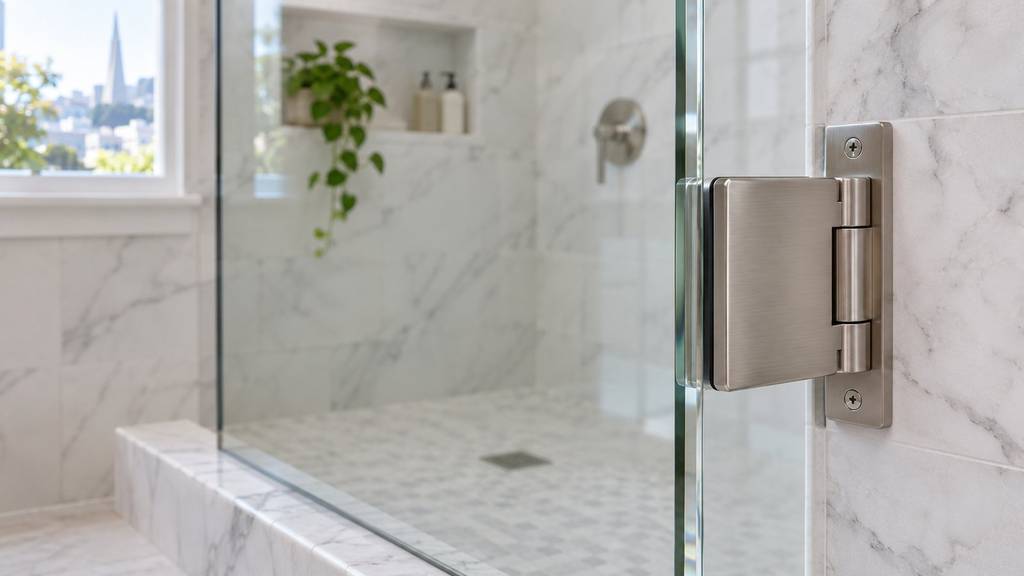
Shower door glass thickness ranges from 3/16 inch to 1/2 inch. Frameless shower doors most often use 3/8-inch tempered glass, with 1/2 inch for wide or premium doors, while framed and sliding doors usually use 3/16 to 1/4 inch because the frame supports the edges.
Whatever the thickness, shower door glass is safety glazing under California code, which in practice means tempered glass. Thickness then sets how the door feels, how much it weighs, and what hinges and wall backing it needs.
This guide covers standard thicknesses by door type, glass weight, 3/8 vs. 1/2 inch, tempered glass rules, clear vs. low-iron glass, and how thickness affects hardware. It is written by the Insight Glass team, licensed California contractors (CSLB 599566) who install frameless shower doors, glass railings and commercial storefront glass across the Bay Area, alongside window replacement, since 1987.
What Is the Standard Shower Door Glass Thickness?
The standard shower door glass thickness is 3/8 inch for frameless doors and 3/16 to 1/4 inch for framed and sliding doors. Semi-frameless doors sit in between, usually at 1/4 or 5/16 inch.
| Thickness | Metric (approx.) | Typical door type | Feel | Notes |
|---|---|---|---|---|
| 3/16 inch | 5 mm | Framed sliding and tub doors | Light, some flex | The frame carries the edges of the glass |
| 1/4 inch | 6 mm | Framed, semi-frameless and sliding doors | Firm | Common on budget and rental bathrooms |
| 5/16 inch | 8 mm | Semi-frameless doors and some sliding systems | Firm | Less common; a step between framed and frameless |
| 3/8 inch | 10 mm | Frameless hinged doors and fixed panels | Solid, very little flex | The usual choice for frameless showers |
| 1/2 inch | 12 mm | Wide frameless doors and tall panels | Very solid, heavy swing | Needs hinges and backing rated for the weight |
Frameless glass has to stand on its own, held only by hinges and clamps, so it needs more thickness than framed glass to stay rigid. A framed door can use thinner glass because the metal frame stiffens it on all four sides.
How Much Does Shower Door Glass Weigh?
Glass weighs about 13 pounds per square foot per inch of thickness, so 3/8-inch shower glass weighs about 4.9 pounds per square foot. A typical 28 by 76 inch frameless door in 3/8 inch glass weighs roughly 73 pounds.
| Thickness | Weight per square foot | 28 x 76 inch door (about 14.8 sq ft) |
|---|---|---|
| 3/16 inch | About 2.5 lb | About 36 lb |
| 1/4 inch | About 3.3 lb | About 48 lb |
| 3/8 inch | About 4.9 lb | About 73 lb |
| 1/2 inch | About 6.5 lb | About 97 lb |
Weight matters most on hinged doors. Every pound hangs from two or three hinges and pulls on the wall behind the tile each time the door opens.
Is 3/8 or 1/2 Inch Glass Better for a Shower Door?
For most frameless shower doors, 3/8 inch glass is the right thickness: it is rigid, safe and works with standard frameless hinges. Choose 1/2 inch when the door is wide, the glass is very tall, or you want a heavier, more solid feel and the wall can carry it.
- 3/8 inch suits: standard alcove showers, door-and-panel layouts in 48- and 60-inch openings, and most frameless remodels.
- 1/2 inch suits: doors near the upper width limit, floor-to-ceiling panels, large fixed walls with no support bar, and projects where a thicker edge is part of the design.
- Trade-offs of 1/2 inch: about a third more weight than 3/8 inch, heavier hinges and clamps, more demand on the wall backing, and a higher glass and hardware cost.
Thicker glass does not make a door safer on its own. Both thicknesses are tempered and meet the same safety glazing standard; the difference is rigidity, feel and how much the hardware has to hold.
Why Must Shower Door Glass Be Tempered?
Shower door glass must be tempered, or another approved safety glazing, because California code treats glass in shower and tub enclosures as a hazardous location. The 2025 California Residential Code (Section R308.4.5) and California Building Code (Section 2406.4.5) require safety glazing in walls, doors and enclosures facing a shower or tub where the bottom edge of the glass is less than 60 inches above the standing surface.
Glass in any swinging or sliding door is also a hazardous location in its own right (CRC Section R308.4.1), so a shower door is covered twice. Safety glazing must pass the federal impact test for glazing in doors and enclosures (16 CFR 1201).
Tempered glass is heat-treated so it resists impact far better than ordinary annealed glass and, if it does break, crumbles into small, blunt pieces instead of long, sharp shards. Laminated glass also qualifies as safety glazing, but tempered glass is the standard for shower doors.
Tempered glass cannot be cut, drilled or notched after it is tempered. Every hinge hole, clamp notch, and handle hole is made before tempering, which is why you order shower glass only after a final field measurement.
How Can You Tell If Shower Door Glass Is Tempered?
The quickest way to tell if shower door glass is tempered is to look for a small permanent mark, often called a bug, etched or fired into one corner. Code requires each pane of safety glazing in a hazardous location to carry a permanent manufacturer’s identification (CRC Section R308.1).
- Corner mark: look for a small etched or sandblasted label in a lower corner that names the safety standard.
- Polarized sunglasses: looking through polarized lenses at an angle often shows faint dark bands or spots, a stress pattern left by tempering.
- Edges: shower door glass has smooth, polished edges; raw or sharp edges are a warning sign.
- Age: shower doors installed before the federal safety glazing standard took effect may not be tempered at all.
If an older door has no mark and you cannot confirm it is safety glass, replacing it is the cautious choice, especially in a bathroom used by children.
Should You Choose Clear or Low Iron Glass for a Shower?
Standard clear glass has a faint green tint from the iron in it, which shows at the edges and through thick 3/8- and 1/2-inch panels. Low iron glass has most of that iron removed, so it looks nearly colorless and lets white tile, marble and stone read truer.
| Feature | Standard clear glass | Low iron glass |
|---|---|---|
| Color | Slight green tint, most visible at the edges | Nearly colorless |
| Best with | Neutral, beige and darker tile | White tile, marble and bright, minimal bathrooms |
| Thickness effect | Tint deepens as glass gets thicker | Stays clear at 3/8 and 1/2 inch |
| Safety | Tempered to the same standard | Tempered to the same standard |
| Cost | Base price | Costs more than standard clear |
Low iron is a looks choice, not a safety upgrade. Our best type of glass for shower doors guide compares frosted, textured, and tinted options. In parts of the Bay Area where water leaves spots, a factory-applied protective coating also makes clear glass easier to keep clean.
How Does Glass Thickness Change Shower Door Hardware?
Thicker glass needs hinges, clamps and wall backing rated for its weight and thickness. Hardware is sized to the glass, so a hinge made for 3/8 inch glass will not hold a 1/2 inch door, and a heavy door needs solid blocking behind the tile, not just drywall or backer board.
- Hinges: rated by glass thickness and maximum door weight and width. Heavier or wider doors may need a third hinge.
- Wall backing: hinges on a tiled wall should anchor into solid framing or blocking. In remodels, add blocking before the tile goes up.
- Clamps and channels: fixed panels are held by clamps or a U-channel sized to the glass thickness.
- Support bars: tall or wide fixed panels may need a support bar to the wall or ceiling, especially in thinner glass.
Insight Glass sizes hinges to each door’s weight and checks the wall backing before installing frameless shower doors, so the glass stays level and the door closes cleanly for years.
Frequently Asked Questions
What thickness is frameless shower door glass?
Frameless shower door glass is most often 3/8 inch (about 10 mm) tempered glass. Wide doors, tall panels and premium installs use 1/2 inch (about 12 mm). Frameless glass needs this thickness because only hinges and clamps hold it, with no frame to stiffen it.
Is 3/8 inch glass thick enough for a shower door?
Yes. 3/8 inch tempered glass is the usual thickness for frameless shower doors and is rigid enough for standard door widths. Move to 1/2 inch only for wide or very tall glass, or if you want a heavier feel and the wall backing can carry it.
Does shower door glass have to be tempered?
Yes. California code treats glass in shower doors and enclosures as a hazardous location, so it must be safety glazing (CRC Section R308.4.5 and CBC Section 2406.4.5). Tempered glass is the standard choice, and laminated glass also qualifies.
How much does a 3/8 inch glass shower door weigh?
3/8 inch glass weighs about 4.9 pounds per square foot. A typical 28 by 76 inch frameless door weighs about 73 pounds, and the same door in 1/2 inch glass weighs about 97 pounds.
Can tempered shower glass be cut to fit?
No. Tempered glass shatters if it is cut, drilled or notched after tempering. All cuts and holes are made first, so the opening must be field-measured before the glass is ordered.
Is low iron glass worth it for a shower door?
It is worth considering for white or marble tile and thick frameless glass, where the green tint of standard glass is most visible. It costs more and does not change safety, so in bathrooms with darker or warmer tile, standard clear glass usually looks fine.
Choosing the Right Shower Door Glass Thickness
Match the thickness to the door type first: 3/16 to 1/4 inch for framed and sliding doors, 1/4 to 5/16 inch for semi-frameless, and 3/8 inch for most frameless doors, with 1/2 inch for wide or tall glass. Then confirm the hinges and wall backing suit the weight, and decide between clear and low iron glass based on your tile.
Insight Glass measures, supplies and installs tempered glass shower doors across the Bay Area. Call (707) 746-6571 for an in-home measurement and a written quote.
Code references are based on the 2025 California Residential Code and California Building Code, effective January 1, 2026. Requirements change, and local amendments apply. Confirm with your building department before ordering.
Disclaimer: The information provided in this article is for general informational purposes only and does not constitute professional or contractor advice. Thicknesses and weights shown are typical industry figures, not product specifications, and every shower should be field measured before glass is ordered. Code references reflect California requirements as published at the “Updated” date shown at the top of this article and are subject to amendment and local jurisdiction modifications. Insight Glass Inc is a licensed California contractor (License #599566). Contact us for a written quote on your shower door project.

