Choosing a commercial storefront installer comes down to six checks: the license, storefront-specific experience, how the installer handles code, what the bid actually includes, how the work fits around your business, and what you get in writing at closeout. A contractor who answers all six clearly is a safe hire. One who can only answer the price question is not.
The storefront is the most-used opening in a commercial building. When it is installed poorly, the problems show up later as leaks at the sill, doors that drag or fail to latch, and inspections that do not pass. This guide walks through each check in the order you would use it, for property owners, property managers, and general contractors hiring for a renovation or tenant improvement in the San Francisco Bay Area.
The Six Checks at a Glance
| Check | What to ask for | Why it matters |
|---|---|---|
| License | CSLB license number, classification, bond, workers’ comp | Confirms the company can legally do glazing work in California |
| Experience | Storefront projects similar to yours | Storefront framing and entrances are a specialty trade |
| Code | How they handle safety glazing, Title 24, accessibility, permits | Code problems surface at inspection, after the glass is in |
| Bid | A line-item scope, not a single number | Low bids often leave out demolition, hardware, or permits |
| Schedule | Lead times and a plan for keeping the business open | Storefront framing and glass are made to order |
| Closeout | Warranty terms and closeout documents in writing | Tells you who to call when a door or seal fails |
Step 1: Confirm the License, Bond and Insurance
Start with the CSLB license lookup. One search shows whether the license is active, which classifications it holds, whether a contractor bond is on file, and whether the company carries workers’ compensation or has filed an exemption.
Check the classification, not just the status. Glass and glazing work falls under the C-17 Glazing classification. If a general contractor is quoting a glazing-only job, ask who will do the glazing work and check that company’s license as well.
Then ask for insurance in writing:
- A certificate of insurance showing commercial general liability coverage.
- Additional insured status for your company or property owner, if your lease or GC contract requires it.
- Workers’ compensation coverage, which protects you if someone on the crew is hurt on your site.
Finally, look for a local office. An installer based in the Bay Area knows how local building departments handle storefront permits and can get back to your site quickly when a door needs adjustment after turnover.
Step 2: Check for Storefront-Specific Experience
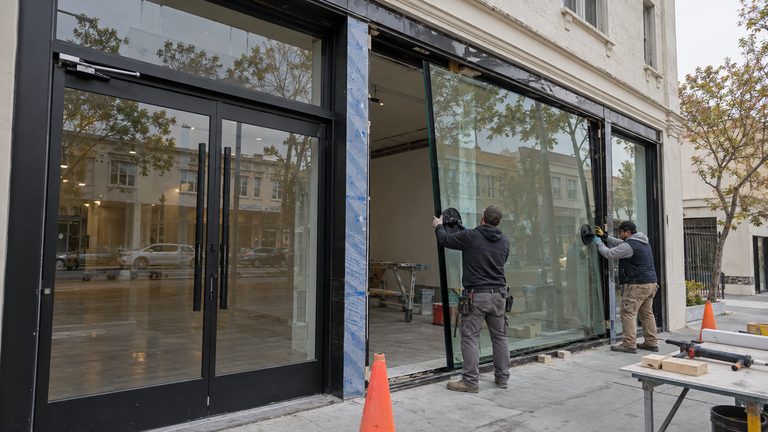
Storefront work is its own trade. It involves aluminum framing systems, large glass units, entrance doors, closers, panic hardware, and often automatic operators. A general glass shop or a carpenter with a glass supplier may be able to set a window, but a storefront entrance that meets commercial code is a different job.
Ask each installer for projects similar to yours:
- Same building type. Retail frontage, an office lobby, a leasing office, a restaurant, or a mixed-use ground floor.
- Same kind of job. New construction, a tenant improvement build-out, or replacing an existing storefront while the building stays occupied.
- Same components. If your project includes automatic doors or full-glass entrance doors, ask to see completed entrances, not just glass panels.
Photos are a starting point. A reference from a property manager or GC on a similar job tells you more about how the installer handles schedules, change orders, and punch lists.
It also helps to know which system you need before you call. A storefront is ground-level aluminum glazing for entries and retail frontage. Window wall and curtain wall are floor-to-floor or hung systems used on mid- and high-rise buildings. Many storefront installers do not take on curtain wall work, so confirm the installer handles the system your building calls for. Our guide on what a storefront window is covers the basics.
Step 3: Ask How They Handle Code, Engineering and Accessibility
Most storefront code problems are found at inspection, after the glass is set. Ask each installer how they handle these five areas before you sign.
Safety glazing. The California Building Code requires safety glass in doors and in glass next to doors, among other hazardous locations. Commercial entrances typically use tempered glass, and laminated glass where security or impact resistance matters.
Title 24 energy. Storefront glass on a conditioned building has to meet California’s Title 24 energy standards for U-factor and SHGC (Solar Heat Gain Coefficient). That usually means Low-E insulated glass units in thermally broken aluminum framing. Ask how the installer documents compliance for your permit.
Accessibility. Commercial entrances in California are reviewed against CBC Chapter 11B. It covers door clear width, opening force, hardware type and height, thresholds, and automatic operators. A storefront installer should be able to tell you how your entrance doors and hardware meet these rules.
Wind and seismic. Storefront framing and its anchors have to carry wind load and allow for building movement. On larger openings, the building department may ask for shop drawings and engineering calculations.
Permits. Ask who pulls the permit, who answers plan check comments, and whether permit fees are in the bid.
Step 4: Compare Bids Line by Line
Storefront bids are hard to compare because each contractor includes different things. The lowest number often leaves out an item another bid includes. Ask every installer for a line-item scope and check it against this list:
| Bid item | What to confirm |
|---|---|
| Field measurement | Who measures, and when, before anything is ordered |
| Framing system | System type, thermally broken or not, and finish color |
| Glass make-up | Low-E, insulated, tempered, or laminated, by opening |
| Doors and hardware | Door type, closers, panic hardware, locks, automatic operators |
| Demolition and disposal | Removal and haul-away of the existing storefront |
| Temporary protection | Board-up or securing the opening overnight |
| Sealants and flashing | Perimeter sealant and sill flashing at every opening |
| Permits and engineering | Permit fees, shop drawings, calculations if required |
| Schedule | Submittal, fabrication, and installation dates |
| Warranty | Manufacturer and workmanship coverage, and for how long |
Once the scopes match, the prices become comparable. For typical price ranges by system and project size, see our guide to how much storefront windows cost.
Step 5: Plan the Installation Around Your Business
Storefront framing and glass are made to order, so the schedule starts well before anyone arrives on site. Ask for the timeline in writing: submittals and approvals, fabrication, and installation. Lead times vary by system, glass type, and season, so get the installer’s current figure rather than relying on an average.
If the building stays open during the work, ask how the installer will handle it:
- Phasing. Replacing openings in sections so one entrance stays usable.
- Working hours. Whether the crew can work around your business hours or your other trades.
- Security. How the opening is secured if a section is left open overnight.
- Coordination. Who your point of contact is, especially on a tenant improvement with a GC and several trades on site.
Property managers with several buildings should ask whether the installer runs multi-site programs, so replacement work across a portfolio follows one standard and one schedule.
Step 6: Get the Warranty and Closeout in Writing
A storefront carries two kinds of warranty, and they cover different things:
- Manufacturer warranties cover the framing finish, the insulated glass seal, and the door hardware.
- The installer’s workmanship warranty covers how it was put in: anchorage, sealants, door alignment, and leaks.
Ask how long each lasts and who you call for each. Then confirm what you receive at closeout: a walkthrough and punch list, code sign-off, warranty documents, and a record of the framing system, glass, and hardware installed so future replacements match.
Commercial Storefront Installation with Insight Glass
Insight Glass is a licensed, bonded, and insured glazing contractor (CSLB 599566) based at 393 E Channel Rd in Benicia, and has served the San Francisco Bay Area since 1987.
On commercial projects, we install aluminum storefront systems, including center-glazed and thermally broken framing; commercial entrances, including automatic and ADA-compliant storefront doors; tenant improvement glazing; and spandrel and insulated glass units. On larger projects, we also price window wall and curtain wall. We work as a glazing subcontractor for general contractors and developers, and directly for owners and property managers, and we provide a certificate of insurance with your company named as additional insured when the project requires it.
Every project follows the same process: you send your plans, photos, or project details; we review the drawings, field-measure, and confirm scope; you receive a written bid and an installation timeline; we install around your trades and hours; and closeout includes a walkthrough, code sign-off, and warranty documents. Recent work includes a leasing office storefront entrance with black aluminum framing and full-glass double doors, and interior office glazing with transom panels and a full-glass entry door. See more on our commercial storefront windows page and our commercial glazing services.
We install commercial storefronts across the Bay Area, including Benicia, Vallejo, Fairfield, Napa, Concord, Walnut Creek, Oakland, Berkeley, Fremont, Pleasanton, San Rafael, San Mateo, Palo Alto, San Jose, Santa Clara, San Francisco, and Sacramento.
Frequently Asked Questions
How do I choose a qualified commercial storefront installer for a renovation?
Check six things: an active CSLB license with the right classification and insurance on file, completed storefront projects similar to yours, a clear answer on how they handle code and permits, a line-item bid, a written schedule that works around your business, and written warranty terms. A contractor who answers all six clearly is a safe choice.
What license does a storefront glass installer need in California?
Glass and glazing work falls under the CSLB C-17 Glazing classification. You can confirm a contractor’s license status, classifications, bond, and workers’ compensation coverage on the CSLB license lookup. If a general contractor quotes the job, ask who will do the glazing work and check that company’s license as well.
Should I hire a glazing contractor or a general contractor for a storefront?
For a storefront replacement on its own, a glazing contractor usually handles the work directly. On a larger renovation, the general contractor typically hires a glazing subcontractor for the storefront. Either way, the company setting the framing and glass should have storefront experience and the right license.
What should a commercial storefront bid include?
A complete bid covers field measurement, the framing system and finish, glass make-up, doors and hardware, demolition and disposal, temporary protection, sealants and flashing, permits and engineering, the schedule, and the warranty. Compare bids only after the scopes match.
Can storefront work be done while my business stays open?
Usually, yes. Installers can phase the work so one entrance stays usable, schedule around business hours, and secure any open section overnight. Agree on the plan before work starts and get it in writing.
What is the difference between a storefront installer and a curtain wall installer?
A storefront is ground-level aluminum glazing for entries and retail frontage. Curtain wall is a hung glass system that runs up multiple floors on mid- and high-rise buildings. Many storefront installers do not do curtain wall work, so confirm the installer handles the system your building needs.
Choosing a Commercial Storefront Installer for Your Bay Area Project
The right commercial storefront installer is the one who can show you an active license with the right classification, finished storefronts like yours, a clear plan for code and permits, and a line-item bid with a written schedule and warranty. Price matters, but only once the scopes are the same.
Insight Glass provides written bids for commercial storefront projects across the Bay Area. Send your plans, openings, or photos through our commercial storefront windows page, or call (707) 746-6571.
Code references checked against published California Building Code sources, October 2026. Requirements change and local amendments apply. Confirm with your building department before ordering.
Disclaimer: The information provided in this article is for general informational purposes only and does not constitute professional, legal, engineering, or contractor advice. Code references reflect California requirements as published at the “Updated” date shown at the top of this article, and are subject to amendment and local jurisdiction modifications. License and insurance status for any contractor should be confirmed directly with the Contractors State License Board and the insurer. Insight Glass Inc is a licensed California contractor (License #599566). Contact us for a written bid on your commercial storefront project.