Most Bay Area homeowners start the window replacement process by typing “window replacement near me” into Google and clicking the first three results. That seems efficient. It also explains why, on average, the contractors most homeowners hire aren’t the best fit for the project, and why a chunk of those projects show up later in our office as repair work after another company’s install went sideways.
The Google Local Pack (the three-business map result that appears first) is a starting point, not an answer. The contractor closest to your address may or may not be the right one. The contractor with the most reviews may or may not be doing the kind of work you need. We’ve spent years competing in the Bay Area window market, and we’ve also seen the post-install fallout when homeowners pick the wrong windows. This guide walks through how to vet a window contractor in the Bay Area, what to ask, what to look for in a quote, and what to expect from the first call to the day of installation.
Table of Contents
1. Why “Near Me” Usually Surfaces 3 Contractors (Local Pack)
When you search “window replacement near me,” Google shows a Local Pack: a map with three business listings pinned to it. Below that are organic search results. Most homeowners click only the Local Pack.
The three-pack is determined by Google’s local ranking algorithm, which weighs three main factors: proximity (how close the business is to the searcher), prominence (online reputation, review volume, brand authority), and relevance (whether the Google Business Profile and website actually match the search). Distance matters most; reviews and prominence break ties.
The Local Pack is where the search starts. It’s the wrong place for the search to end.
2. Beyond the Local Pack: How to Actually Vet
A real vetting process takes about an hour of homeowner research before any quote visit. The workflow we recommend:
| Vetting Step | What You’re Looking For |
|---|---|
| Read individual reviews, not star counts | Read the bottom-tier reviews specifically. The pattern of complaints (communication, no-shows, warranty stonewalling) tells you what goes wrong on this contractor’s projects. |
| Search “company name + complaints” and “company name + BBB” | Third-party sources show you the worst-case customer experience. |
| Check Yelp, Houzz, and Angi separately | A contractor strong on Google but weak on Houzz often has a sales-first culture. |
| Look for similar project reviews | A great installer of 2010s tract windows isn’t automatically a great installer of period-correct SDL muntins on a Willow Glen Spanish Revival. |
| Get three quotes | Always. The spread tells you what the market actually charges. Lowest isn’t best; highest isn’t either. |
3. License, Insurance, and Bond Checks
California requires specific credentials for residential window contractors. Verifying these takes 15 minutes and protects you from the most common bad-contractor scenarios.
| Credential | What to Verify |
|---|---|
| CSLB License | California Contractor’s State License Board requires either a C-17 (Glazing) or B (General Building) license. Verify on cslb.ca.gov: license is current, classification is correct, no complaints, no settlements, no recent disciplinary action. |
| Workers’ Comp Insurance | Required by California law if the contractor has employees. Without it, an injured worker on your property can hold you liable. Ask for proof, not verbal confirmation. |
| General Liability Insurance | Typical residential coverage is $1M to $2M. Request a Certificate of Insurance (COI) listing your name as an additional insured for the project. A real contractor produces this in a day or less. |
| Contractor’s Surety Bond | California requires a $25,000 contractor’s bond. Protects you if the contractor fails to complete work or violates contracting laws. Verify on cslb.ca.gov. |
| RRP Certification (pre-1978 homes only) | EPA Renovation, Repair, and Painting cert required for any work disturbing paint on pre-1978 housing. Lack of RRP cert is a federal violation, not a paperwork issue. |
Want to see a complete, vetted quote? Insight Glass produces line-itemed proposals with license, insurance, and warranty details written out — so you can compare apples to apples.
Call 707-746-65714. Questions to Ask on a Quote Visit
A serious quote visit takes 60 to 90 minutes. Here’s the list of questions we recommend homeowners bring with them.
Quote Visit Question Checklist
If a contractor can’t answer most of these in a single visit, the contract probably won’t cover them either.
5. Red Flags in Window Quotes
The quotes themselves tell you a lot before you ever sign anything. The flags we see most often:
- “Today only” pricing pressure. Legitimate contractors don’t run high-pressure same-day discounts. If the price drops $5,000 if you sign before the salesperson leaves, the original price was inflated and the discount is theatrical.
- Massive discounts off “list price.” “60 percent off retail” is a marketing tactic, not a real discount. The actual installed cost compared to other quotes is what matters.
- Vague glass and frame specifications. The quote should list U-factor, SHGC, frame depth, chamber count, corner construction, and warranty terms. Generic phrasing like “energy-efficient Low-E glass” means the contractor either doesn’t know or doesn’t want you to know.
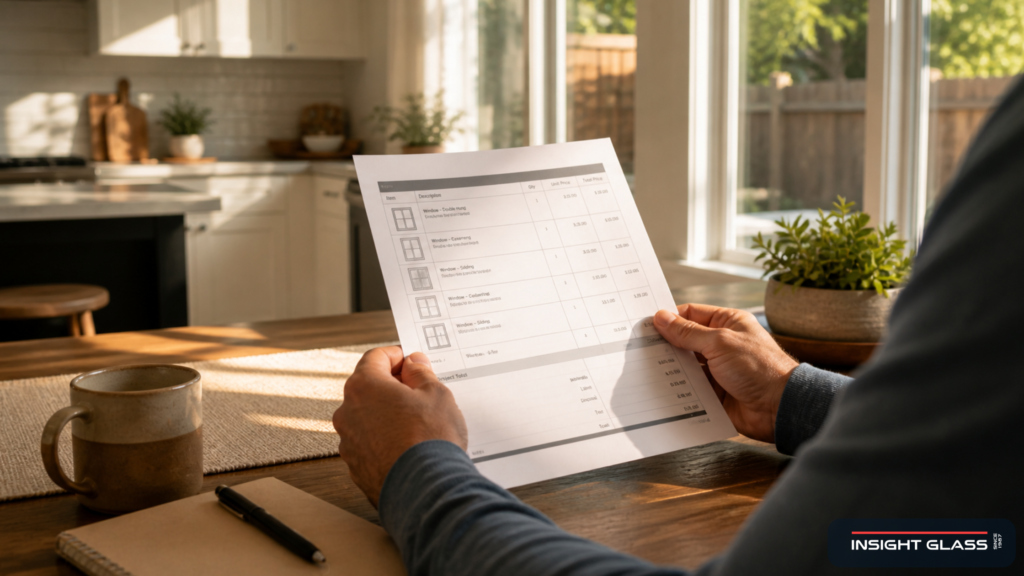
- Missing line items. Permits, Title 24 documentation, dump fees, sealants, hardware, screens, and final inspection should all be itemized or explicitly listed as included. A single-total quote is hiding the trade-offs.
- No license number on the quote. California law requires the CSLB license number to appear on contracts and proposals over $500. Missing a license number is a violation.
- No RRP mention for pre-1978 homes. A contractor who doesn’t mention lead-safe handling on a pre-1978 home is either not RRP-certified or planning to skip the protocol. Both are problems.
- Cash-only or contract-by-handshake. California law requires written contracts on residential work over $500. Cash-only with no paperwork makes warranty disputes impossible to resolve.
- Door-to-door sales. Legitimate Bay Area window contractors don’t go door-to-door. The companies that do are typically high-pressure operations.
- Full payment up front. California limits residential contractor deposits to 10 percent or $1,000, whichever is less. A contractor demanding more is either inexperienced or planning to walk.
6. Insight Glass Service Area
We’re headquartered in Benicia and serve the broader Bay Area plus Sacramento metro:
Bay Area Counties We Serve
HQ: Benicia, CA7. What to Expect: First Call to Install Day
A real Bay Area window project follows a fairly predictable timeline. Here’s what to expect from initial contact through final inspection.
Initial Inquiry
Phone or online conversation about scope: number of windows, home era, project priorities, timeline.
In-Home Assessment
We measure every opening, check existing frames for rot or settlement, identify code or HOA issues. No charge, no obligation.
Detailed Proposal
Line-itemed quote with specification tier options, permit fees, Title 24 docs, warranty terms, and payment schedule.
Contract
Sign in person or via secure email. 10 percent deposit per California law.
Permit Application
Depending on the city. Over-the-counter approvals are faster than plan check.
Manufacturing
Depending on frame material and glass package. Custom colors and divided lites add lead time.
Pre-Install Scheduling
We confirm the install date and walk you through prep — furniture, access, parking.
Install
Most residential whole-home projects run 2 to 4 days. Retrofit is faster than full-frame.
Window Replacement Near Me: How to Make the Right Choice
The “window replacement near me” search is the right starting question and the wrong stopping point. The contractor closest to your home may be the right fit, or it may not. The vetting work — license verification, insurance check, review reading, three-quote comparison, red-flag review of the proposal — takes about an hour and saves you from the most common bad-contractor outcomes: surprise change orders, warranty stonewalling, code violations, and projects that drag months past the original timeline.
If you’d like a free in-home assessment for your Bay Area window project, we’re happy to walk through your home, measure every opening, identify any historic or code considerations, and give you a real quote you can compare against others. That’s how the “near me” search actually pays off: by ending with the right contractor, not just the closest one.
8. Frequently Asked Questions
Insight Glass — your Bay Area window experts since 1987.
Call 707-746-6571 for a Free Quote!
CONTACT US FOR A FREE ASSESSMENT