Most homeowners researching projecting windows start with “bay window” and discover “bow window” partway through. The two products are related but meaningfully different, and the right one for your home depends on factors that don’t usually appear in brochures: architectural era, room-view priority, available wall length, and how the curved-versus-angular geometry reads against the rest of your facade.
We’ve installed both styles on Bay Area homes across most architectural eras. This guide is the comparison conversation we have with homeowners stuck between the two. By the end, you’ll know which style fits which architecture, what the cost difference actually is, and how the install, maintenance, and resale realities differ.
Table of Contents
- The Visual Difference (Angular vs. Curved)
- Cost Comparison: Bay Wins on Price
- Light and View Differences
- Architectural Fit by Bay Area Home Style
- Install Complexity Differences
- Maintenance Over Time
- Resale Impact in Bay Area Markets
- How to Decide Which Is Right for Your Room
- Frequently Asked Questions
1. The Visual Difference (Bay = 3 Panes Angular, Bow = 4-6 Panes Curved)
The headline difference is geometry.
Bay Window
- From above, the shape is a stretched hexagon.
- Angles read as hard transitions between lites.
- Three distinct view directions on a 3-lite.
- Projects further from the wall plane for the same width.
- Room reads with a clear “front” (center light) and “sides” (angled lights).
Bow Window
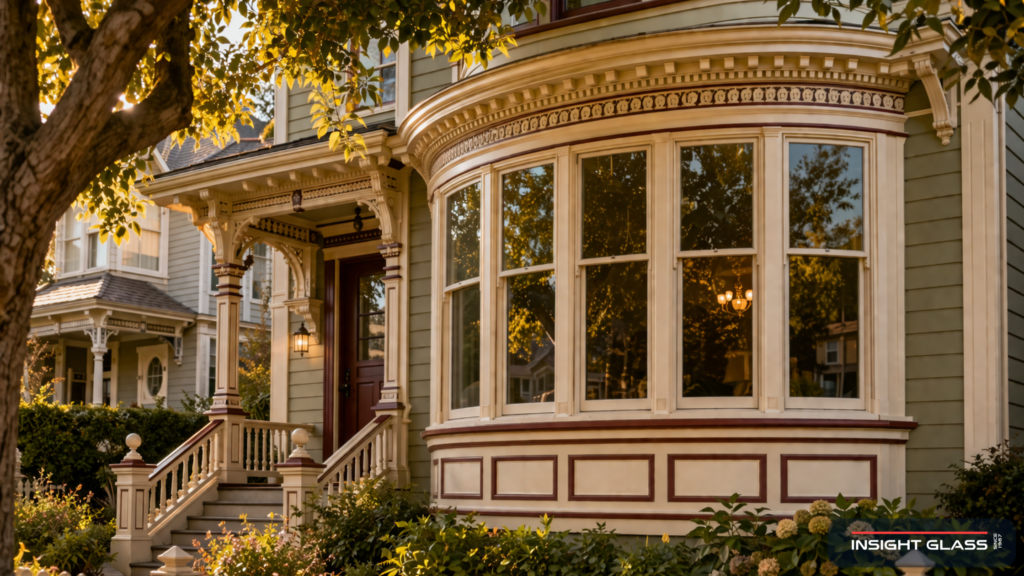
- From above, the shape is a curved segment of a circle.
- Transitions between lites are subtle; overall reads as smooth curve.
- Views blend into a continuous panorama.
- Projects less but covers more wall length.
- Curve creates a more uniform interior without a single focal direction.
For a deeper read on how bay window assemblies are constructed, see our bay window installation cost guide.
2. Cost Comparison: Bay Windows Usually Win on Price
Bay windows are almost always cheaper than equivalent-width bow windows. The reasons are structural and manufacturing:
| Cost Driver | How Bow Adds Cost |
|---|---|
| Window unit count | A 4-lite bay needs 4 units; a 5-lite bow needs 5 (or more). More units = more product cost. |
| Frame fabrication | Bay windows use standard angles that manufacturers stock as catalog products. Bow windows require precise smaller angles (18° to 22.5°), often custom-ordered. |
| Roof and structural complexity | Bay roofs are flat planes that flash with standard methods. Bow roofs are conical or curved-pitch, requiring custom flashing details that take more labor. |
| Custom interior trim | Bay trim runs in straight segments matching the angled lites. Bow trim must be custom-bent, segmented, or built up from multiple pieces. |
| 8′ Wide Projecting Window (Vinyl Mid-Grade) | 2026 Bay Area Installed |
|---|---|
| 4-lite canted bay | $7,500–$12,000 |
| 5-lite bow window (curved) | $14,000–$19,000 |
3. Light and View Differences
Both styles let in significantly more light than a flat-wall window of similar opening width, but they distribute it differently.
| Aspect | Bay Window | Bow Window |
|---|---|---|
| View framing | Three distinct view directions; each reads as a separate composition. | Panoramic view that blends across the curve; reads as a single continuous viewport. |
| Light distribution | Light enters in three discrete directions; clear angular shadows. | Light enters smoothly across the curve; softer, more diffuse interior shadows. |
| Best for | Homes with a clear focal feature (a tree, a sightline, a street corner) the center lite can frame. | Homes with a wide street-facing or garden-facing view that benefits from panoramic framing. |
| Interior workspace | More dramatic light angles — useful for plant placement or interior art lighting. | More even interior light — useful for reading or work areas inside the projection. |
| Curb appeal / listings | Photographs cleanly with clear angles. | Generally photographs better in real estate listings because the curved shape is visually distinctive. |
4. Architectural Fit by Bay Area Home Style
The home’s architecture is the first filter on the bay vs bow decision. The wrong style undermines the architectural integrity, even when the product is high quality.
| Era / Style | Right Choice | Why |
|---|---|---|
| Victorian & Edwardian (1870–1915) | Bow (often period-correct) | Italianate and Queen Anne facades already incorporate curved bay assemblies. Curved geometry harmonizes with curved trim and elaborate detailing. |
| Craftsman & Bungalow (1900–1930) | Bay | Craftsman is built on horizontal lines and angular geometry. Bow reads as out-of-period. Canted or box bays with divided-light upper sash are the right call. |
| Spanish Revival & Mediterranean (1920–1940) | Neither dominates | Often uses casement groupings rather than projecting assemblies. When projection is needed, a small canted bay or arched window works better than a bow. |
| Mid-Century Modern & Eichler (1950–1975) | Neither dominates | Mid-century relies on flat picture windows and minimal frames. Some ranches incorporated small canted bays in living rooms; full-bow windows were rare. |
| Ranch & tract homes (1950–1980) | Bay (common); bow uncommon | The right approach for a ranch is usually a 3 or 4-lite canted bay. |
| Modern & Contemporary (1990–now) | Either, but neither typical | Bow reads more traditional, bay more transitional. Truly contemporary homes usually skip both in favor of picture windows or floor-to-ceiling glass walls. |
For a broader context on Bay Area architectural styles and matching window types, see our Bay Area architecture window types guide.
Stuck between bay and bow on your home? We walk the elevation, look at the architectural era, and recommend the geometry that fits — not the one with the bigger margin.
Call 707-746-65715. Install Complexity Differences
Bay and bow windows install differently in ways that affect timeline, contractor selection, and risk:
| Install Aspect | Bay Window | Bow Window |
|---|---|---|
| Structural framing | Standard rectangular rough opening with a header sized to bay’s load. | Continuous wider opening (no center support) with custom header design. Wider span sometimes triggers structural review even on standard installs. |
| Roof construction | Simple shed or hipped roofs in flat planes; flash with standard step-flashing. | Conical or segmented roofs to follow the curve; custom flashing detailing that’s more time-intensive and more prone to failure if not executed carefully. |
| Interior trim | Straight segments matching each lite’s angle. | Custom-bent wood trim (expensive), kerfed straight trim that bends, or short segmented pieces following the curve. |
| Install timeline | 2 to 4 days for residential whole-bay project. | 4 to 8 days due to additional roof, flashing, and trim work. |
| Permit complexity | Standard window permits in most cities. | May trigger additional structural review if the opening width is large. Like-for-like bow replacement rarely faces additional review. |
6. Maintenance Over Time
Both styles need long-term maintenance, but the failure points differ.
| Maintenance Aspect | Bay Window | Bow Window |
|---|---|---|
| Routine maintenance | Standard window unit cleaning and IGU monitoring. Sealant inspection every 5 years. Flashing inspection on the small roof above. | Same standard cleaning and IGU monitoring, but more joints means more inspection points. |
| Common failure points | Bottom rail of side lites or flashing joints between bay roof and main roof. | Conical or curved roof flashing transitions, where water can pool or run off in unexpected directions during heavy rain. |
| Sealant lifespan | 10 to 20 years; shortened by coastal exposure or strong inland UV. | 10 to 20 years; same drivers shorten lifespan. |
7. Resale Impact in Bay Area Markets
Both bay and bow windows add visible architectural character compared to flat-wall windows. The resale impact varies by home type and Bay Area market.
| Where It Adds Value | Notes |
|---|---|
| Bow windows | Victorian and Edwardian restoration projects in Pacific Heights, the Mission, Alameda, and Berkeley historic districts. Period-correct bows can add real value because the comp pool expects them. |
| Bay windows | Mid-century and post-war ranch homes, Craftsman bungalows, and most tract-built homes from 1950 through 2000. |
| Neither helps significantly | Newer modern and contemporary homes, where the comp pool expects floor-to-ceiling glass walls or picture windows. |
8. How to Decide Which Is Right for Your Room
The decision usually narrows quickly when you walk through these questions:
1. What era is the home in?
Victorian or Edwardian leans bow. Craftsman, ranch, or mid-century leans bay. Modern or contemporary leans toward neither (consider a flat picture window instead).
2. What’s the view?
Panoramic view (Bay water, foothills, garden across a wide elevation) leans bow. Focal feature view (a specific tree, sightline, or street corner) leans bay.
3. How wide is the available wall?
Less than 8 feet usually limits the choice to a small bay (3-lite). 10+ feet opens up larger bay or bow possibilities.
4. What’s the budget tolerance?
Bay windows cost 40 to 80 percent less than equivalent bow windows. If the difference is meaningful, bay is often the answer.
5. What’s the maintenance tolerance?
Bow windows have more flashing joints and more potential leak points. Bay windows are simpler to maintain over the decades.
6. What’s the resale strategy?
If you plan to sell within 5 years, the architecturally correct match for your home’s era and comp pool matters more than the homeowner’s personal preference.
Bay Window vs. Bow Window: Making the Right Call for Your Room
The bay vs. bow decision isn’t really about which style is “better.” It’s about which style matches the home’s era, the room’s view, the available wall, the project budget, and the long-term maintenance and resale strategy. Bay windows fit most Bay Area homes (Craftsman, ranch, tract, mid-century) and cost meaningfully less. Bow windows fit naturally into Victorian and Edwardian homes and offer panoramic views at a higher cost. Neither is universally correct; both are correct for the right project.
If you’d like a real assessment of your projecting window project, we offer free Bay Area walk-throughs. We measure the existing wall, identify the architectural era, walk through view and budget priorities, and give you a quote that recommends the style that fits your specific home rather than the one that’s easier to sell. That’s how the bay window vs. bow window decision actually works in 2026: by matching the geometry to the home and the room, not by picking the option with more visible curves.
9. Frequently Asked Questions
Insight Glass — your Bay Area window experts since 1987.
Call 707-746-6571 for a Free Quote!
CONTACT US FOR A FREE ASSESSMENT