Most bay window pricing content online answers the wrong question. Homeowners aren’t really asking “how much does a bay window cost?” They’re asking, “What are my actual options at the size and price points that fit my home?” The first question gets a single number that doesn’t help anyone. The second question gets a usable reference.
This guide is the size-and-price reference we use during walk-throughs in the Bay Area. It covers standard bay window dimensions (small 3-lite through large 5-lite), 2026 installed pricing by size band, the style multipliers that adjust the number of units, the Bay Area install adders that don’t appear in contractor brochures, and the line items that quotes routinely leave out. By the end, you should be able to assess your existing wall opening, match it to a size band, and estimate the cost of your bay window project.
Table of Contents
- Standard Bay Window Sizes (3-Lite, 4-Lite, 5-Lite)
- Bay Window Prices by Size Band
- Style Differences and Price Impact
- Bay Area Install Adders (Structural, Roof, Flashing)
- Material Price Comparison (Vinyl, Fiberglass, Wood-Clad)
- Total Project Price Scenarios
- What’s Typically NOT Included in a Bay Window Quote
- Frequently Asked Questions
1. Standard Bay Window Sizes (3-Lite, 4-Lite, 5-Lite)
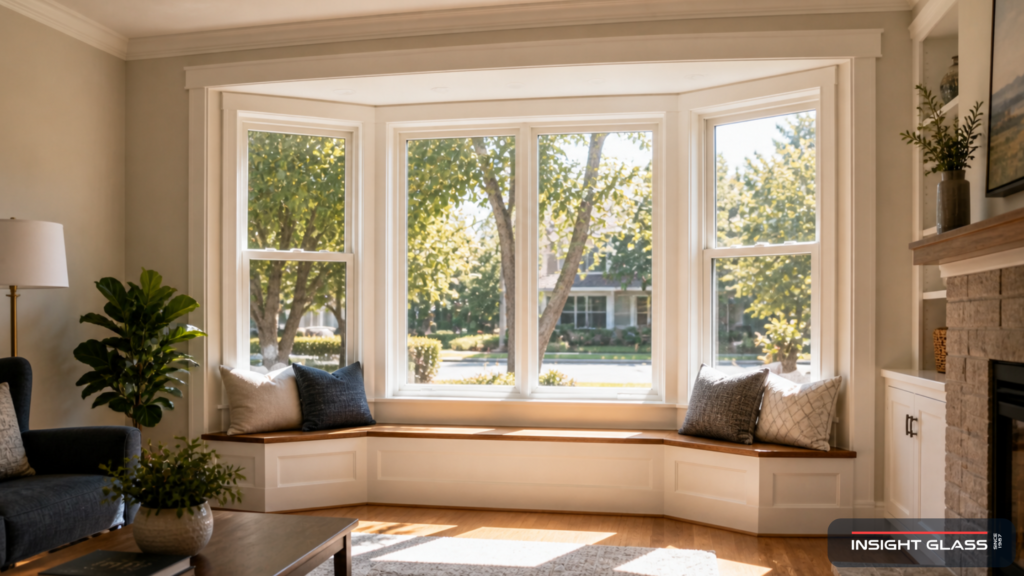
Bay windows are not single units. They are assemblies of three to five separate window lites joined at angles, with a continuous header and sill, a small roof above, and a finished interior trim package. The configuration count and total width define the size.
3-Lite
Center lite plus two angled side lites. Most common in single-bedroom replacements, breakfast nooks, and smaller living rooms.
4-Lite
Wider than a 3-lite for more glass area without going to a 5-lite footprint. Common in mid-size living rooms and dining rooms.
5-Lite
Center plus two angled side lites plus two additional outer-angle lites. Common in larger living rooms, family rooms, and feature elevations.
| Other Configurations | Description |
|---|---|
| Bow window | 5 to 7 lites in a continuous curve (no angled segments). Width 8′ to 14′. Pricier than canted bays of equivalent footprint. |
| Garden bay | Small projecting bay typically 4′ wide × 4′ tall, with built-in shelving and a glass roof for plants. Most often over a kitchen sink. |
| Custom sizes | Any width or height outside the manufacturer’s standard offerings. Typically a 20 to 40 percent premium over the closest standard size. |
For a deeper material-by-material breakdown of how these sizes price out, see our bay window installation cost guide.
2. Bay Window Prices by Size Band
Pricing assumes mid-grade vinyl frames with double-pane solar control Low-E glass, like-for-like replacement in an existing bay opening, in a typical Bay Area location. Adjustments for material, style, and adders are covered in later sections.
Small (3-Lite, 6′ × 4′): $4,500 to $7,500 installed
Cost Breakdown
- Standard window units$1,500–$3,000
- Framing and structural$1,000–$2,000
- Install labor and finish$1,500–$2,500
- Permits, dump, walk-through$500–$1,000
- Total$4,500–$7,500
Small-medium (3-lite, 7′ × 4’6″): $5,500 to $8,500 installed
Medium (4-Lite, 8′ × 4’6″): $7,500 to $12,000 installed
Cost Breakdown
- Standard window units$2,800–$5,000
- Framing and structural$1,500–$3,000
- Install labor and finish$2,200–$3,500
- Permits, dump, walk-through$500–$1,000
- Total$7,500–$12,000
Large (5-Lite, 10′ × 5′): $11,000 to $17,500 installed
Cost Breakdown
- Standard window units$4,500–$8,000
- Framing and structural$2,500–$4,500
- Install labor and finish$3,000–$4,500
- Permits, dump, walk-through$700–$1,200
- Total$11,000–$17,500
Extra-Large (5+ Lite, 12′ wide or 5’6″+ tall): $16,000 to $25,000+ installed
Custom orders are almost always required. Structural complexity adds variability. Roof tie-in usually requires modifications. These bands hold for canted bay configurations in standard mid-grade vinyl. Style and material adjustments cover the remaining variance.
Have a bay opening you want priced? We measure on site, identify the right size band, and quote a firm number — not a calculator estimate.
Call 707-746-65713. Style Differences and Price Impact
The five common bay window styles produce different prices for the same opening width.
| Style | Multiplier | Description |
|---|---|---|
| Canted (25°–45°) | 1.00× baseline | Most common in Bay Area homes. Side lites angle outward from the center; the assembly looks like a stretched hexagon from above. |
| Box (90° angles) | 1.10–1.15× | Side lites perpendicular to the wall, creating a rectangular projection. More wood, more roof area, more complex flashing. |
| Oriel (cantilevered) | 1.30–1.50× | Bay projects from a wall above the ground floor with no support beneath it. Requires structural engineering and steel or heavy-wood cantilever framing. Adds $2,000–$6,000 in structural cost. |
| Garden (with shelving and glass roof) | 1.20–1.30× | Most often over kitchen sinks. Built-in shelves and overhead glass for plants. Smaller footprint than a 3-lite bay, but custom fit. |
| Bow (curved, 5–7 lites) | 1.40–1.80× | Continuous arc rather than angled segments. More glass units, more complex framing, custom curved interior trim. The largest premium of any standard style. |
For 2025-dated pricing on bay window replacement specifically, see our cost of bay window replacement 2025 guide, which covers the prior year’s ranges as a reference for 2026 inflation adjustments.
4. Bay Area Install Adders (Structural, Roof, Flashing)
The base prices in Section 2 assume like-for-like replacement in an existing bay opening on a single-story home with an accessible lot. Real Bay Area projects often add complexity:
| Adder | Cost Impact | When It Applies |
|---|---|---|
| Structural header replacement | $1,500–$4,000 | Existing header undersized for new bay assembly, or project upsizes the opening. |
| Roof modification | $1,500–$5,000 | New bay openings or larger replacements typically need roof reframing. Like-for-like may reuse existing roof structure. |
| Cantilever framing (oriel) | $2,000–$6,000 | Upper-floor bay without ground-floor support. Includes structural engineering review. |
| Permit fees | $200–$800 | Higher in San Francisco; lower in Walnut Creek, Concord, and most East Bay cities. |
| Title 24 (CF1R) | Usually included | Verify on the quote. Required by California energy code. |
| Lead remediation (pre-1978) | $300–$1,500 | RRP-certified handling for any work disturbing paint. |
| Asbestos remediation (pre-1978) | $500–$3,000 | If testing reveals asbestos in caulking, siding, or insulation. |
| Hillside / upper-floor access | +15–25% labor ($750–$2,500) | Hillside lots, scaffold access, or upper-floor bays. |
| Custom interior trim & built-in seat | $1,500–$5,000 | Bay window seat with storage. Significant carpentry and finish work. |
| HOA design review | $0–$500 | Charged separately by the HOA, not by the contractor. |
5. Material Price Comparison (Vinyl, Fiberglass, Wood-Clad)
Frame material is the second biggest pricing driver after size. Approximate multipliers off the mid-grade vinyl baseline:
| Material | Multiplier | When It Fits |
|---|---|---|
| Vinyl (mid-grade) | 1.00× baseline | The Bay Area default. Welded corners, multi-chamber profile, compression weatherstripping. White, beige, or heat-rated dark colors. |
| Fiberglass | 1.25–1.50× | Lower thermal expansion than vinyl (better for inland heat zones), slimmer sightlines, durable in coastal exposure, available in dark colors without heat-warping concerns. |
| Wood-clad fiberglass | 1.40–1.80× | Wood interior, fiberglass exterior. Right for higher-end aesthetic projects where the interior reads as wood (warmth, paint, or stain options). |
| Solid wood | 1.60–2.00× | Architecturally significant homes (Willow Glen, Pacific Heights, Berkeley Elmwood, Naglee Park). Requires repaint every 5 to 10 years. |
| Aluminum | Rarely used | Higher thermal conductivity makes it a poor energy choice; condensation issues on cold mornings. |
6. Total Project Price Scenarios
Three real-shape Bay Area scenarios that combine size, style, material, and adders into actual installed totals.
1962 Ranch, 3-Lite Canted Bay, Vinyl Mid-Grade
- Size: 6’6″ × 4’6″, 3-lite canted
- Material: White vinyl mid-grade
- Glass: Double-pane solar control Low-E
- Project: Like-for-like replacement, existing bay opening, single-story
- Notes: No structural changes, no roof modifications beyond minor flashing
1985 Two-Story, 4-Lite Box Bay, Fiberglass
- Size: 8′ × 4’6″, 4-lite box bay (90° angles)
- Material: Fiberglass in factory white
- Glass: Spectrally selective Low-E (west-facing exposure)
- Project: Replacing failed original bay; rebuilding small roof above due to flashing failure; minor structural header upgrade
- Notes: HOA approval required (added 4 weeks to timeline)
1924 Craftsman, 5-Lite Bow Window, Wood-Clad with Built-In Seat
- Size: 10’6″ × 5′, 5-lite bow (curved)
- Material: Wood-clad fiberglass (wood interior)
- Glass: Double-pane Low-E with passive coating (north-facing)
- Project: Period-correct restoration replacing failed original; SDL muntin profiles to match original; full custom interior trim and built-in storage seat below
- Notes: Pre-1978 RRP-certified handling required; Berkeley Landmarks Preservation Commission design review
The variance across these scenarios isn’t unusual. Bay window pricing spans a 10x range, from the smallest standard 3-lite vinyl to the largest custom bow with restoration-quality wood-clad and built-ins. Locating your project within this range requires honestly walking through size, style, material, and add-ons.
7. What’s Typically NOT Included in a Bay Window Quote
Bay window quotes routinely omit items homeowners expect but didn’t read carefully. The most common exclusions:
| Exclusion | What to Budget Separately |
|---|---|
| Interior built-in seating or storage | Finish carpentry, not window installation. Add $1,500 to $5,000 if it’s part of your vision. |
| Custom interior trim or paint matching | Standard quote includes basic trim. Period-correct profiles or custom paint matching are usually separate line items. |
| Drywall repair and paint | Patching, mudding, sanding, and matching paint are sometimes excluded unless specified. |
| Window treatments | Curtains, blinds, shades, shutters — never included. Bay windows require specialty hardware ($400–$1,500 above standard). |
| HVAC modifications | If bay opening dimensions change, registers or ducts may need relocation. Usually outside contractor scope. |
| Existing damage repair | Rot, asbestos remediation, structural settling, or hidden water damage typically billed as change orders. |
| HOA design review fees | Charged by the HOA separately. |
| Permit expediting fees | Standard permits included; expediting (when available) is sometimes extra. |
| After-hours work premium | Weekend or evening installs add 15–25% labor premium. |
| Disposal of unrelated materials | Old curtains, blinds, or other items not directly part of the window assembly are often the homeowner’s responsibility. |
Bay Window Sizes and Prices: Using This Reference for Your Project
The bay window size and price references serve as a starting point, not a final quote. The size band gives you a rough idea of what to expect at a baseline. The style multiplier and material multiplier adjust the baseline up or down. The Bay Area install adders cover the variables that depend on your specific home (era, condition, location, hillside, HOA). The exclusion list keeps the quote-comparison fair across contractors.
If you’d like a real assessment for your bay window project, we provide free Bay Area walk-throughs. We measure the existing opening, identify which size band fits, walk through style and material options for your home, flag the adders that apply to your specific situation, and give you a quote that reflects your project, not a generic price. That’s how bay window sizes and prices actually become your project total: by matching the right combination to your house, your neighborhood, and your priorities.
8. Frequently Asked Questions
Insight Glass — your Bay Area window experts since 1987.
Call 707-746-6571 for a Free Quote!
CONTACT US FOR A FREE ASSESSMENT