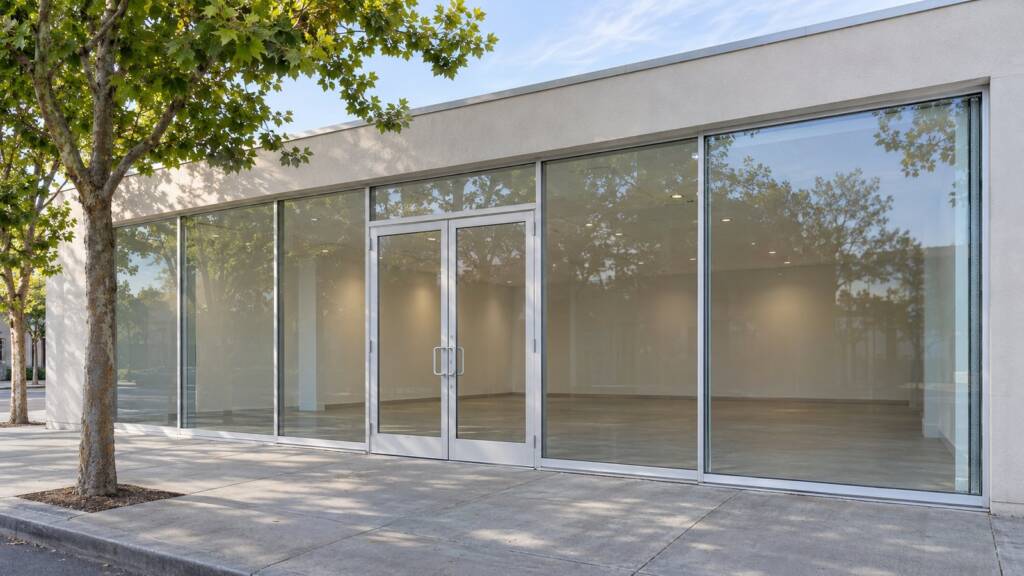
Storefront glass is the glazing set into the aluminum framing at the front of a commercial building. The main storefront glass types are tempered, laminated, insulated, low-e coated, and security glass, and most Bay Area storefronts combine two or more in a single unit.
The right glass depends on four things: where California code requires safety glazing, what the energy code requires, how much security and noise control the business needs, and the budget. Clear glass that looks identical from the sidewalk can perform very differently once it is hit, heated by the afternoon sun, or tested by a break-in attempt.
This guide explains each type of storefront glass, its thickness, where the California Building Code requires safety glass, and how to match the glass to your building. Insight Glass installs storefront glass and framing systems for retail, restaurant, medical, and office buildings across the Bay Area.
Written by the Insight Glass commercial glazing team, licensed California contractors serving Bay Area businesses since 1987. CSLB License #599566.
What Is Storefront Glass?
Storefront glass is commercial-grade glass installed in a non-load-bearing aluminum framing system, usually on a building’s ground floor. It fills the large fixed panels beside and above the entrance, the sidelights next to the doors, and the entrance doors themselves.
“Storefront glass” is not one product. It is a category that covers several glass types, and the specification on a quote or a set of drawings names the exact makeup: the glass type, the thickness of each pane, any coating, and the width of the air space in an insulated unit.
A glass storefront has to do more than a typical window. It sits at sidewalk level where people, carts, and deliveries can strike it; it is often the largest glass area on the building and the main target in a break-in. That is why the glass selection matters as much as the framing on commercial storefront windows.
What Are the Main Types of Storefront Glass?
The five main types of storefront glass are tempered, laminated, insulated, low-e coated, and security glass. They are not alternatives to each other in every case. A typical exterior storefront panel is an insulated unit made of two tempered panes, one of which carries a low-e coating.
| Glass type | How it is made | What it does | Where it is used |
|---|---|---|---|
| Tempered | Heated and rapidly cooled after cutting | Resists impact, breaks into small blunt pieces | Doors, sidelites, large low panels |
| Laminated | Two or more panes bonded to a plastic interlayer | Stays in the opening when broken, cuts noise and UV | Security, sound control, overhead glass |
| Insulated (IGU) | Two panes sealed around an air or gas space | Slows heat transfer | Exterior walls of conditioned spaces |
| Low-e coated | Thin metallic coating on one glass surface | Reflects heat while passing visible light | Inside an insulated unit |
| Security | Thicker or multi-layer laminated makeups | Delays forced entry | Street-level retail, high-value stock |
Tempered glass
Tempered glass is the standard safety glass in storefronts. It is cut to size, then heated and cooled quickly, which leaves the surfaces in compression. As a result, it resists roughly four times the load of ordinary annealed glass of the same thickness.
When tempered glass does break, it breaks all at once into small, relatively blunt pieces instead of long shards. That’s why codes accept it in doors and other locations where a person could fall into the glass.
Two limits are worth knowing. Tempered glass cannot be cut, drilled, or reshaped after tempering, so every panel is made to a final measured size. And once it breaks, the opening is empty, which matters for security.
Laminated glass
Laminated glass is two or more panes bonded to a plastic interlayer, usually polyvinyl butyral or a stiffer ionoplast. When it breaks, the fragments stay stuck to the interlayer, and the panel stays in the frame.
That one property gives laminated glass three uses in a storefront:
- Security: a broken panel still blocks the opening, which slows an intruder.
- Sound control: the interlayer dampens vibration, so laminated glass passes less street noise than a single pane of the same thickness.
- UV protection: the interlayer blocks most ultraviolet light, which reduces fading of merchandise and flooring.
Laminated glass can also qualify as safety glazing when it meets the impact standard the code references.
Insulated glass units
An insulated glass unit, or IGU, consists of two panes sealed around a spacer with an air- or argon-filled gap between them. The gap slows heat transfer, so the interior glass surface stays closer to room temperature in winter and summer.
Almost every exterior storefront on a heated or cooled space in California uses insulated glass, because single glazing cannot meet the energy code. The panes in the unit can be tempered, laminated, or a combination of both, depending on the location’s requirements.
Low-e coated glass
Low-e (low emissivity) glass has a microscopically thin metallic coating on one surface, normally a surface facing the sealed gap of an insulated unit. The coating reflects heat while letting most visible light through.
For a storefront, the practical effect is a cooler interior on a west-facing frontage and lower heating loss on cold mornings, without darkening the display. Different coatings balance solar control and daylight differently, so the coating is chosen for the building’s orientation and climate zone.
Security glass
Security glass is laminated glass built to resist forced entry. It uses thicker interlayers, multiple layers, or both, so repeated blows crack the glass but don’t quickly open a hole.
No glass makes a storefront impossible to break into. Security glazing buys time, and time is what makes most smash-and-grab attempts fail. It is common on jewelry, electronics, pharmacy, and cannabis retail frontages, and on street-level glass in dense commercial districts.
Tinted, reflective and obscure glass
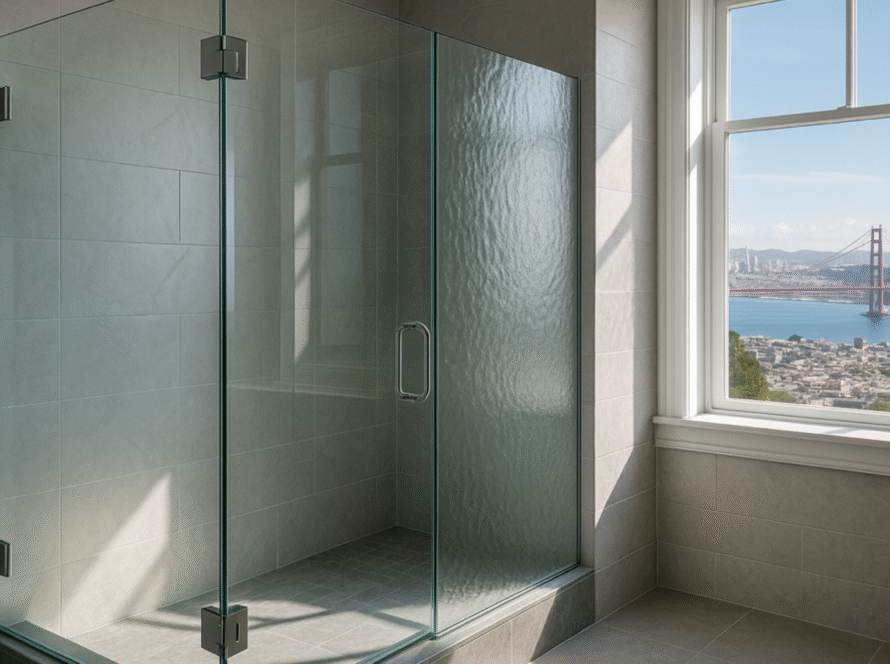
Tinted and reflective glass reduce glare and solar heat by absorbing or reflecting some sunlight. Obscure glass, such as frosted or patterned glass, provides privacy for clinics, offices, and restrooms while still letting in light. These are appearance and comfort options layered on top of the safety and energy choices above.
How Thick Is Storefront Glass?
Most exterior storefront glass is a 1-inch insulated unit made of two 1/4-inch panes with a 1/2-inch gap. Single-pane storefront glass, used on interior partitions and unconditioned spaces, is usually 1/4 inch tempered.
| Application | Typical makeup | Typical overall thickness |
|---|---|---|
| Interior storefront or unconditioned space | Single pane, tempered | 1/4 inch |
| Exterior storefront, conditioned space | Insulated unit: two 1/4 inch panes, 1/2 inch gap | 1 inch |
| Laminated safety or sound glass | Two panes bonded to an interlayer | 1/4 to 9/16 inch |
| All-glass entrance doors | Single pane, tempered | 3/8 to 1/2 inch |
| Security glazing | Multi-layer laminated | 3/8 inch and up, set by the security rating |
These are common makeups, not fixed rules. The California Building Code (Section 2404) requires exterior glass to be sized for the wind load at the site, so a tall panel on an exposed corner in San Francisco or along the Carquinez Strait can need thicker glass than the same panel on a sheltered street. The framing system also sets a limit, because each storefront frame accepts a specific range of glass thickness.
Where Does California Code Require Safety Glass in a Storefront?
The California Building Code requires safety glazing in “hazardous locations,” and a typical storefront has several. Under Section 2406.4 of the 2025 California Building Code, which took effect January 1, 2026, safety glass is required in these storefront locations:
- Glass in doors (Section 2406.4.1): all glass in swinging and sliding entrance doors.
- Glass next to doors (Section 2406.4.2): glass within 24 inches of either side of a door, where the bottom edge of the glass is less than 60 inches above the walking surface. This covers most sidelights.
- Large low panels (Section 2406.4.3): a panel that is larger than 9 square feet, has its bottom edge less than 18 inches above the floor, has its top edge more than 36 inches above the floor, and has a walking surface within 36 inches of the glass. All four conditions must apply.
Most floor-to-ceiling storefront panels meet all four conditions in the third rule, which is why storefront glass is so often tempered throughout.
Safety glazing means glass that passes the impact tests the code references (CPSC 16 CFR Part 1201 or ANSI Z97.1). In practice, that is tempered or laminated glass. In an insulated unit, each pane in a hazardous location must be safety glass, not just the outer one.
Each piece of safety glass carries a permanent mark, usually etched in a corner, naming the manufacturer or installer and the standard it meets (Section 2406.3). An inspector looks for that mark. If a panel in a hazardous location has no mark, expect it to be flagged.
The exceptions and details depend on the building and the opening. Confirm the requirements for your project with the local building department or a design professional before glass is ordered. This section describes what the code requires; it is not a compliance review of any specific storefront.
Which Storefront Glass Meets Title 24 Energy Requirements?
Insulated glass with a low-e coating is the standard way to meet the California Energy Code (Title 24, Part 6) for storefronts. The code sets three values for glazing on nonresidential buildings, and the limits for storefront systems are listed by climate zone in Table 140.3-B of the 2025 Energy Code:
- U-factor: how fast heat passes through the glass and frame. Lower is better, and the code sets a maximum.
- Solar heat gain coefficient (SHGC): how much of the sun’s heat comes through. Lower means less heat, and the code sets a maximum.
- Visible transmittance (VT): how much daylight comes through. The code sets a minimum, so very dark glass can fail even when its heat numbers pass.
The ratings apply to the whole assembly, glass and frame together. A thermally broken aluminum frame is often needed alongside the glass to reach the required U-factor.
The Bay Area spans several climate zones. The coast and San Francisco sit in Climate Zone 3, the South Bay in Zone 4, the North Bay in Zone 2, and the inland East Bay in Zone 12, where summer heat makes solar control more important. A glass package that suits a foggy Daly City frontage is not automatically the right one for a west-facing shop in Concord or Livermore.
Replacement glazing in an existing building is also covered by the energy code, with its own set of requirements for alterations. Insight Glass confirms the required values for the project’s climate zone before a glass package is quoted.
Tempered vs Laminated Storefront Glass: Which Should You Choose?
Choose tempered glass when you need safety glazing at the lowest cost, and choose laminated glass when the storefront also needs security, sound control, or UV protection. Both can satisfy the safety glazing rules.
| Factor | Tempered | Laminated |
|---|---|---|
| Meets safety glazing rules | Yes | Yes, when rated for impact |
| After breakage | Falls out of the opening in small pieces | Cracks but stays in the frame |
| Break-in resistance | Low once broken | Higher, delays entry |
| Sound control | Same as ordinary glass of equal thickness | Better |
| UV blocking | Minimal | Blocks most UV |
| Cut on site | No | No for tempered-laminated, sometimes for annealed-laminated |
| Relative cost | Lower | Higher |
Many storefronts use both. A common upgrade is an insulated unit with a tempered outer pane and a laminated inner pane, which keeps the opening closed after a break and adds sound control without changing the storefront’s look.
Which Storefront Glass Fits Your Business?
The glass should follow the risks and conditions of the specific frontage. These are the most common matches:
- General retail and offices: insulated units with tempered panes and a low-e coating. This meets safety and energy requirements at the lowest cost.
- Restaurants and cafes: the same base package, with laminated glass on frontages that face traffic noise.
- High-value retail (jewelry, electronics, pharmacy, cannabis): laminated security glazing on all street-level panels and doors.
- Medical, dental and professional offices: laminated glass for sound privacy, with obscure glass where patients need visual privacy.
- West and south-facing frontages inland: a solar control low-e coating to limit afternoon heat gain.
- Coastal and bayside locations: glass sized for higher wind loads, with attention to frame finish and sealants, since salt air shortens the life of exposed metal and seals.
- Busy arterial streets: laminated glass, or an insulated unit with panes of two different thicknesses, to cut traffic noise.
When a business changes use, the glass is worth a second look. A space that worked as an office with standard tempered glass may need security glazing when it becomes a retail store with stock in the window.
How Does Glass Type Affect Storefront Cost?
Glass type is one of the biggest variables in storefront pricing. Single-pane tempered glass sits at the low end. Insulated low-e units cost more, laminated units cost more again, and rated security glazing sits at the high end.
Three other glass factors move the price:
- Panel size: very large panels need thicker glass, more labor, and sometimes lifting equipment.
- Lead time: tempered and laminated glass is made to order, so custom sizes and special coatings take longer than stock makeups.
- Framing: thicker or heavier glass can require a deeper or reinforced frame.
For current Bay Area price ranges by system type, see our guide to storefront window costs.
Frequently Asked Questions
What type of glass is used for storefronts?
Most storefronts use tempered glass, and most exterior storefronts use it in insulated units with a low-e coating. Laminated glass is added where the business needs security, sound control, or UV protection.
How thick is storefront glass?
Single-pane storefront glass is usually 1/4 inch tempered. Exterior storefront glass on a heated or cooled space is usually a 1-inch insulated unit made of two 1/4-inch panes and a 1/2-inch gap. Wind load, panel size, and security needs can increase the thickness.
Does storefront glass have to be tempered?
It must be safety glazing wherever the California Building Code defines a hazardous location, including doors, glass within 24 inches of a door, and most large panels near the floor. Safety glazing can be tempered or laminated glass. In practice, nearly all glass in a typical storefront falls under these rules.
Is laminated or tempered glass better for a storefront?
Neither is better in every case. Tempered glass costs less and meets the safety rules. Laminated glass stays in the frame when broken, so it is the better choice where break-ins, noise, or fading are concerns.
Can storefront glass be replaced without replacing the frame?
Often, yes. If the aluminum framing is sound and accepts the thickness of the new glass, the glass can be replaced on its own. Moving from single-pane to insulated glass usually requires a different frame because the glazing pocket is too narrow for a 1-inch unit.
Does replacing storefront glass require a permit?
It depends on the city and the scope of work. Replacing glass in the same opening is treated differently from changing the framing or opening size, and replacement glass in a hazardous location still has to be safety glazing. Check with the local building department before work starts.
Choosing Storefront Glass for Your Bay Area Building
Start with what the code requires: safety glazing in doors, sidelites, and large low panels, and an insulated low-e package that meets the energy code for your climate zone. Then decide whether the frontage needs laminated glass for security or sound. Those two steps settle most storefront glass decisions.
Insight Glass installs storefront glass and aluminum storefront systems for businesses across the Bay Area. Call (707) 746-6571 for an on-site assessment and a written quote.
Glass makeups and thicknesses in this article are typical industry ranges as of November 2026, not product data. Code references are based on the 2025 California Building Code and California’s 2025 Building Energy Efficiency Standards (Title 24, Part 6), effective January 1, 2026. Glass selection depends on each building’s loads, location, and performance requirements.
Disclaimer: The information provided in this article is for general informational purposes only and does not constitute professional, engineering, or contractor advice. Storefront glass should be specified for each building’s wind, safety glazing, and energy code requirements. Code references reflect California requirements as published at the “Updated” date shown at the top of this article and are subject to amendment and local jurisdiction modifications. Insight Glass Inc. is a licensed California contractor (License #599566). Contact us for a written quote on your storefront project.