The single most expensive mistake we see homeowners make in a window replacement project is not choosing the wrong glass package or the wrong frame material. It’s picking the wrong mullion pattern.
Wrong window mullions in a Victorian house make it look like it was renovated by someone who didn’t know the era. Wrong mullions on a Craftsman bungalow flatten the architectural character that adds 5 to 8 percent to the home’s resale value in markets like Berkeley, Rockridge, and Pacific Heights. The right mullions, by contrast, are nearly invisible: they read as “of course this house has these windows,” and the rest of the home’s design holds together.
We’ve replaced windows on enough Bay Area homes across enough architectural eras to know which mullion patterns belong on which houses, and which compromises hold up over a 20-year ownership period. This guide walks through the patterns by era, the cost premiums for getting the detail right, and the decisions that matter most when you’re staring at a contractor’s submittal package and trying to choose.
Table of Contents
- Mullions vs. Muntins: Clearing Up the Terminology
- Why Mullion Design Matters in 2026 (Resale, Light, Character)
- Victorian and Edwardian Bay Area Homes
- Craftsman and Bungalow: Vertical and Divided-Light Styles
- Mid-Century Modern and Eichler: Minimal or No Mullions
- Modern and Contemporary: Black Grid, Oversized Light
- Spanish Revival and Mediterranean
- When to Add or Remove Mullions
- Cost Impact of Grilles, TDL, and SDL
- Frequently Asked Questions
1. Mullions vs. Muntins: Clearing Up the Terminology
Half the conversations we have about mullions are actually about muntins, because the words get used interchangeably in the field, even though the building code and architectural reference works distinguish them.
Mullion (technically)
A vertical or horizontal structural divider between separate window units. The piece between two adjacent casement windows, or the post separating a fixed lite from an operable sash.
Muntin (technically)
The thin strips that divide a single sash into multiple smaller panes. The grid pattern in a colonial-style window with eight or twelve small panes is made of muntins, not mullions.
2. Why Mullion Design Matters in 2026 (Resale, Light, Character)
Three reasons getting mullion design right is worth the effort:
Architectural Integrity Drives Resale
A 1907 Edwardian with replacement single-pane sheets, where the original 6-over-1 sash used to be, can lose 3 to 8 percent of its valuation compared to a comp with period-correct windows. In Pacific Heights, North Berkeley, and the Berkeley Hills, this is real money.
Light Transmission Drops With Density
Each muntin blocks visible light. A heavily divided sash (Craftsman 9-over-1) transmits roughly 8 to 12 percent less daylight than a single-lite equivalent. In a dark north-facing room, that matters.
Character Persists Across Decades
Window patterns are one of the most visible features of a home’s elevation. Get them right, and the home’s character holds through ownership changes. Get them wrong, and every future owner fights the windows.
HOA and Historic Review
In some Bay Area neighborhoods (Berkeley historic districts, San Francisco Article 10 landmark properties, Alameda’s Gold Coast, Pacific Heights), HOA or city design review may require period-correct mullion patterns on replacement windows. Confirm before you spec.
3. Victorian and Edwardian Bay Area Homes: Traditional Mullion Patterns
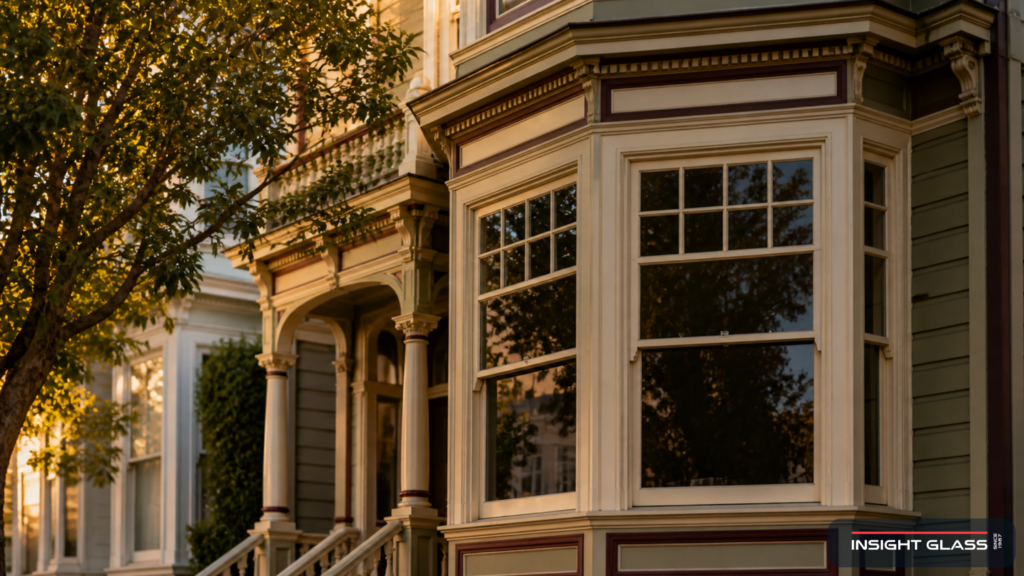
Bay Area Victorians and Edwardians were built primarily between 1870 and 1915, with the densest concentrations in San Francisco’s Pacific Heights, Western Addition, Mission, and Castro neighborhoods, plus Oakland’s Adams Point and Old Oakland, and Alameda’s Gold Coast. The Italianate, Queen Anne, Stick, and Edwardian sub-styles each have their own mullion vocabulary.
| Sub-Style | Era | Mullion Pattern |
|---|---|---|
| Italianate | 1870s–1880s | 1-over-1 or 2-over-2 double-hung, narrow muntins, often with stained or etched upper-sash decoration. Tall, narrow proportions. |
| Queen Anne | 1880s–1900 | 6-over-1 or 4-over-1 with patterned upper sash containing colored or beveled glass (“cottage windows”). Asymmetric facades and turret bays. |
| Stick / Eastlake | 1880s–1890s | Similar to Queen Anne but with crisper rectilinear muntins and less decorative upper-sash glass. |
| Edwardian | 1900–1915 | Simpler than Victorian. Often 1-over-1 with no muntins on the lower sash, sometimes a single horizontal mullion separating the upper sash from a transom above. |
For a deeper read on SF Victorian and Edwardian replacement decisions specifically, our Victorian and Edwardian San Francisco home window replacement guide covers the historic-resource considerations in detail.
Replacing windows on a historic Bay Area home? Insight Glass walks the property, identifies the original mullion pattern, and specifies a period-correct replacement that holds resale value.
Call 707-746-65714. Craftsman and Bungalow: Vertical and Divided-Light Styles
Bay Area Craftsman and California Bungalow homes were built between roughly 1900 and 1930, with peak concentrations in Berkeley (Elmwood, Northbrae, Claremont), Oakland (Rockridge, Temescal, Adams Point), Alameda, and parts of Pacific Heights and Cole Valley. The architectural detail signature is “honest” exposed materials and craftsman-built joinery, including substantial wood window casings and divided-light upper sash.
4-over-1 (Most Common)
The defining Craftsman pattern. Four vertical lights in the upper sash, single lite below. Found in nearly every East Bay Craftsman bungalow.
6-over-1 and 9-over-1
More elaborate, often on substantial homes, feature windows, or Tudor crossovers. Heavier muntin density and stronger visual presence.
Casement With Leaded or Art Glass
Many Craftsman homes have a feature window (living room or stair landing) where art glass or leaded patterns make the mullion structure part of the composition.
Profile and Material
Craftsman muntins are thicker than Victorian muntins: typically 7/8″ to 1-1/8″ wide, with a more pronounced profile. Wood is usually old-growth fir or redwood, painted or stained darker than the trim.
5. Mid-Century Modern and Eichler: Minimal or No Mullions
Bay Area Mid-Century Modern homes, including Eichler tracts in the South Bay (Sunnyvale, Mountain View, Palo Alto), Marin (Lucas Valley, Marinwood, Terra Linda), and parts of San Mateo County, were built between roughly 1950 and 1975. Their architectural signature is the opposite of Victorian and Craftsman: minimal mullions, large glass areas, slim frames, and indoor-outdoor flow.
- Large fixed lites with no muntins.
- Slim aluminum framing (originally non-thermally broken, single-pane).
- Floor-to-ceiling glass walls in atrium and great-room areas.
- Slim mullions only where structurally required to span large openings.
Replacement strategy for Eichler and Mid-Century Modern homes: retain the minimal-frame aesthetic. Slim aluminum or fiberglass frames in dark anodized or matte black finish. Resist the urge to add SDL grilles to “warm up” the look. The lack of muntins is the architectural statement.
For a broader breakdown of architectural styles and matching window types across the Bay Area, our architecture window types Bay Area style guide covers the era-by-era recommendations.
6. Modern and Contemporary: Black Grid, Oversized Light
Modern and contemporary homes built from 1990 onward, plus large-scale renovations in places like the Mission District, SOMA, and parts of the Berkeley and Oakland Hills, lean into a different mullion vocabulary entirely.
Industrial Black Grid
Large fixed lites divided by black-painted SDL or true steel muntins into 6, 9, or 12-pane patterns. Warehouse-conversion or loft aesthetic. Common in SF Mission, Hayes Valley, and West Berkeley adaptive-reuse projects.
Oversized Single Lite
Floor-to-ceiling glass with no mullions. Slim black or bronze frames. Common in newer custom homes in the Berkeley Hills, Woodside, and Atherton.
Strip Windows
Long horizontal openings divided by minimal vertical mullions. Common in modern hillside homes where the window follows a long elevation line.
SDL vs GBG Shifts Here
GBG is acceptable for Modern industrial-grid looks because the aesthetic is meant to be flat and graphic rather than period-authentic. Cost savings of 50 to 70 percent versus TDL, and the look reads correctly.
7. Spanish Revival and Mediterranean: Wrought-Iron-Style Grilles
Bay Area Spanish Colonial Revival and Mediterranean Revival homes were built primarily in the 1920s and 1930s, with concentrations in the Berkeley Hills, parts of Oakland, Russian Hill, and selected pockets of Marin and the Peninsula.
- Casement windows with small-pane divided lites: typically 4-pane or 6-pane casements paired in arched or rectangular openings.
- Wrought-iron-style grilles: applied muntin patterns that mimic wrought iron. Heavier and more decorative than Craftsman or Victorian muntins.
- Arched and shaped openings: a defining feature requiring custom-curved framing and matching mullion patterns on replacement.
- Tile and plaster surrounds: trim is often tile or textured plaster rather than wood casing, and the window reads more recessed.
8. When to Add or Remove Mullions During a Window Replacement
Two common decisions on replacement projects:
Adding Mullions Where None Existed
Appropriate when a 1970s tract house is being aesthetically upgraded to a Craftsman or Cottage style. Inappropriate when adding 4-over-1 grilles to an Eichler or Modern home, which erases the architectural intent.
Removing Original Mullions
Almost never appropriate on a historic home. Replacing a 6-over-1 Victorian sash with a single-pane sheet makes the home look like it was renovated by someone who didn’t know what they had. Resale comp value declines over time.
Removing 1980s “Added Grilles”
Often appropriate. Removable internal grilles (the snap-in plastic kind) added to flat-faced ranches trying to look “colonial” are best taken out during a window replacement.
Bay Area HOA and Historic Review
Berkeley’s Landmarks Preservation Commission, San Francisco’s Article 10 properties, and several Alameda historic districts may require design review on mullion changes. Confirm before you spec.
Our historic window replacement guide covers the regulatory framework in detail.
9. Cost Impact of Grilles, True-Divided-Lite, and SDL
The mullion construction method drives a significant portion of the window’s cost. Three options, in descending order of cost and visual authenticity:
| Method | How It’s Built | Premium per Window |
|---|---|---|
| True Divided Lite (TDL) | Each small pane is an individual sealed glass unit, separated by structural muntins that physically divide the sash. Most expensive, most authentic. | $200 to $400 |
| Simulated Divided Lite (SDL) | Single insulating glass unit with grilles bonded to both interior and exterior surfaces. Reads visually like TDL at normal viewing distance. | $80 to $150 |
| Grille-Between-Glass (GBG) | Grilles installed inside the IGU between the two panes. Cheapest. Surface reads flat and reflective; grilles appear to float behind the glass. | $30 to $80 |
| Removable Interior Grilles | Snap-in plastic or wood grilles applied to the interior surface only. Visually obvious as applied decoration. Not recommended for any architectural style. | Lowest (often included) |
Bay Area Mullion Spec Decision Checklist
Window Mullions in Bay Area Homes: Match the Era, Hold the Value
Window mullions are one of the few details on a home where the cost difference between right and wrong is measured in hundreds of dollars, but the visual and resale impact is measured in years. Match the era. Pick TDL or quality SDL on historic homes. Skip grilles on Mid-Century and Modern homes. Confirm HOA and historic-resource requirements before you sign.
If you’d like a walk-through of your home’s existing windows and a recommendation on which mullion approach matches your architecture, we provide free assessments across the Bay Area. We’ll measure, identify the era and original pattern, and provide a specification that fits your house and your neighborhood’s expectations.
Specifying mullions for your Bay Area home? Insight Glass walks every era from Italianate Victorians to modern Eichlers and writes specs that hold architectural integrity and resale value.
Call 707-746-657110. Frequently Asked Questions
Insight Glass — Bay Area architectural window specialists since 1987.
Call 707-746-6571 for a Free Quote!
CONTACT US FOR A FREE ASSESSMENT