Tempered glass requirements are among the most consistently misunderstood aspects of Bay Area window projects. Homeowners assume any double-pane glass is safety glass. Some contractors quietly skip tempering on borderline locations to save a few hundred dollars. Inspectors flag the same handful of mistakes on remodel after remodel, and the cost to fix them after the project is signed off is consistently higher than the cost of getting them right the first time.
We’ve handled the corrections on enough Bay Area inspections to know exactly which locations get missed and why. This guide walks through what the California Building Code actually requires, where it most often gets violated on residential projects, and what the corrections cost in 2026.
Table of Contents
- What Tempered (Safety) Glass Is and How It Differs
- California Building Code Requirements at a Glance
- Bathrooms and Showers (Section 2406)
- Sliding Doors and Side Panels
- Stair Landings, Near-Floor Windows, and Railings
- Bay Area Inspector Flag List (Common Violations)
- Cost to Upgrade Existing Non-Compliant Glass
- Frequently Asked Questions
1. What Tempered (Safety) Glass Is and How It Differs
Tempered glass is annealed glass that has been heat-treated to roughly four times the strength of standard glass and induced to break in a specific failure pattern. The glass is placed in a tempering oven at around 1,150°F, then rapidly cooled with high-pressure air. The surface compresses, the interior tensions. The result is a pane that resists impact harder than annealed and, when it does break, fragments into thousands of small, relatively safe pieces rather than long shards.
Two related but different products often get confused with tempered glass:
Heat-Strengthened Glass
Similar process, less aggressive cooling cycle. Roughly twice as strong as annealed glass, but not classified as safety glass. Does not meet code where tempered is required.
Laminated Glass
Two glass plies bonded with a polymer interlayer. When it breaks, fragments stay attached to the interlayer. Qualifies as safety glass in most locations and is sometimes used in place of tempered for security or sound reasons.
The Identifying “Bug”
Tempered glass has a permanent etched mark in a lower corner showing the manufacturer and the standard met (typically ANSI Z97.1 or 16 CFR 1201). If you can’t find a bug on a pane that should be tempered, an inspector will assume it isn’t.
Cannot Be Field-Modified
Tempered glass cannot be cut, drilled, or modified after tempering. Any cutting or hole-making must happen before the heat-treatment cycle. If your contractor talks about field-cutting tempered glass, something is wrong.
For background on the broader product family, see our types of window glass guide.
2. California Building Code Requirements at a Glance
California Building Code (CBC) Section 2406 is the controlling provision for safety glazing in residential and commercial buildings throughout the state. The 2026 cycle keeps the framework that’s been in place for several code cycles, with minor clarifications.
CBC 2406.4 lists “hazardous locations” where safety glazing (tempered or laminated) is required. The locations break into a few broad groupings:
- Doors and glazing adjacent to doors
- Glazing in walls enclosing wet areas (bathtubs, showers, saunas, spas)
- Glazing near stairways, ramps, and landings
- Glazing in walls and barriers along walking surfaces meeting all four conditions of CBC 2406.4.7
- Glazing enclosing pools, hot tubs, and spas
- Glazing in railings and barriers
The “all four conditions” test in 2406.4.7 is where most Bay Area residential projects intersect with the code. A glazing panel must be tempered if it meets all four of the following:
| Condition | Threshold |
|---|---|
| 1. Exposed area | Larger than 9 square feet |
| 2. Bottom edge | Less than 18 inches above the floor |
| 3. Top edge | Greater than 36 inches above the floor |
| 4. Walking surface | One or more within 36 inches horizontally of the glass |
Most large picture windows and floor-to-ceiling glass in modern Bay Area homes meet all four conditions and require tempered. The bedroom slider that runs from 6 inches off the floor to 7 feet up, with the hallway 30 inches in front of it, must be tempered glass. The 4-foot-square fixed window above a kitchen counter is probably not (the bottom edge is too high for the test to fail).
For the broader picture of where this comes up on residential window projects, see our piece on when tempered glass is required in residential windows.
Not sure which of your windows need tempered glass? Insight Glass offers a free pre-inspection walk-through identifying every code-flagged location before your project hits permit review.
Call 707-746-65713. Bathrooms and Showers (Section 2406)
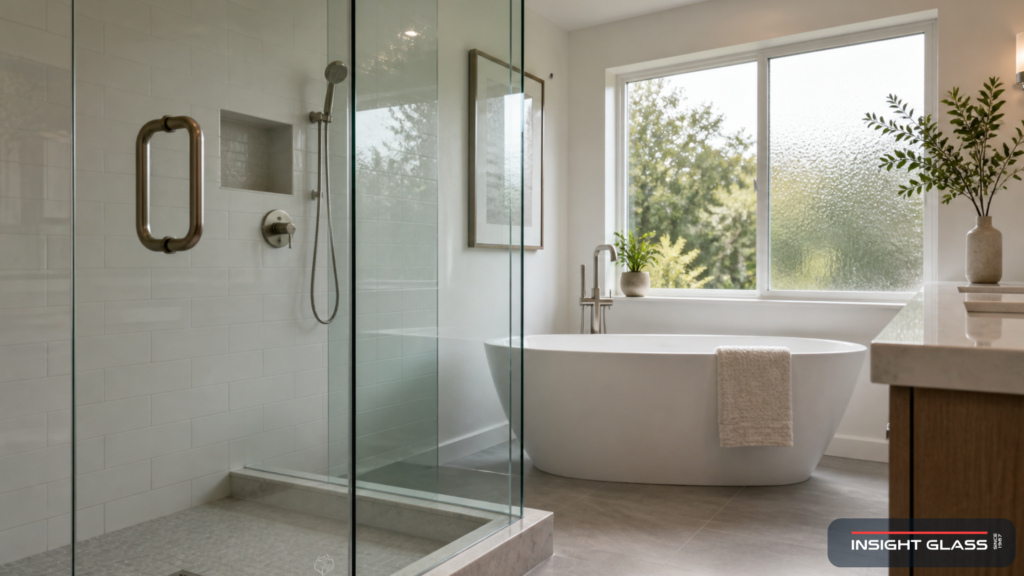
Bathrooms produce the highest concentration of tempered-glass requirements in a typical home, and they’re the location most often violated on older properties and casual remodels.
- All glass enclosing or adjacent to bathtubs, showers, saunas, and spas.
- All glazing within 60 inches above any standing or walking surface in a tub or shower.
- Mirrors over 9 square feet positioned within shower or tub enclosures.
- Glass partitions and dividers in wet areas.
What this means in practice: if you have a window above a bathtub, in the wall of a tub-shower combo, or in any wall directly enclosing a shower stall, that window must be tempered. The age of the home doesn’t matter for new work or remodels. The original installer’s choices don’t matter.
The fix is glass replacement. You cannot temper an existing pane in place. The frame stays, the glass swaps. We typically replace bathroom windows in those scenarios with tempered, obscured glass for privacy, in either a single-pane or an insulated unit, depending on the wall condition.
4. Sliding Doors and Side Panels
All sliding glass doors must be tempered. This is universal under CBC 2406.4.1; there is no condition or exemption that allows a non-tempered sliding patio door in residential construction.
Adjacent to the doors is where it gets specific. CBC 2406.4.2 requires safety glazing in any pane that is:
- Within a 24-inch arc of either vertical edge of the door.
- Where the bottom edge of the glass is less than 60 inches above the floor.
This catches most sidelites flanking entry doors. The narrow vertical glass next to your front door is almost always within 24 inches of the door edge and clearly less than 60 inches off the floor at the bottom. It must be tempered.
French Doors
Tempered glass required in all panes (each leaf is a door under the code). Many older French door installations have non-tempered glass that was never replaced.
Storm Doors and Surrounds
Tempered glass required when the bottom edge of the glass is less than 60 inches above the floor.
Pivot and All-Glass Entry Doors
Trigger tempered automatically. Custom-fabricated all-glass doors with patch fittings (boutique retail, modern luxury homes) require structural review.
Premium Door Pricing
Custom all-glass doors with patch fittings can run $4,000 to $10,000 per opening for the door alone, before installation and surround work.
5. Stair Landings, Near-Floor Windows, and Railings
Stair-related tempered requirements catch a surprising number of homeowners off guard.
- Glass within 36 inches of the top or bottom of a stairway landing where the bottom edge is less than 60 inches above the walking surface.
- Glass within 60 inches horizontally of the bottom landing where the bottom edge is less than 60 inches above the floor.
In a typical Bay Area split-level or two-story home, this means the window at the bottom of the stairs (very common in 1960s-70s homes) must be tempered. The picture window on a stair landing must be tempered. Glazing on a balcony or mezzanine railing must be tempered or laminated.
Near-floor windows in walls along walking paths are governed by the four-condition test. A bedroom window running 12 inches off the floor up to 6 feet, with the door 24 inches away: tempered glass is required. A kitchen window running 36 inches off the counter to 6 feet, with no walking surface within 36 inches: not required.
For sun-exposed locations where glass type matters for both safety and performance, our best glass for sun-facing windows guide covers the trade-offs.
6. Bay Area Inspector Flag List (Common Violations)
After enough projects in San Francisco DBI, Oakland Building, San Jose, Berkeley, and the smaller East Bay jurisdictions, the violation list gets predictable. The five most common tempered-glass flags we see at inspection:
| # | Violation | Where We See It |
|---|---|---|
| 1 | Bathroom windows over tubs | Pre-1990 homes; original aluminum single-pane glazing above a bathtub almost never has the tempered bug. |
| 2 | Sidelites at entry doors | Narrow vertical pane next to the front door, in homes built before tempered glass became standard, often untempered. |
| 3 | Stair-landing windows | Bottom or top of staircases, especially in 1960s split-level homes. Required if bottom edge is below 60 inches and within 36 inches of the landing. |
| 4 | Pool and spa enclosure glass | Pool fence panels and any glass within the pool enclosure must meet safety glazing. Older window walls and unpermitted hot-tub gazebos. |
| 5 | Granny flats and ADU additions | Garage-to-ADU conversions often retain the original aluminum slider in the walking-surface zone without tempering. SF and Oakland specifically check ADU glazing. |
7. Cost to Upgrade Existing Non-Compliant Glass
The cost of fixing a tempered-glass violation depends on whether you can replace just the glass or need to replace the entire window unit.
| Glass-Only Replacement | 2026 Bay Area Cost |
|---|---|
| Standard tempered insulated unit (1-inch IGU, tempered both lites) | $30 to $80 per sq ft, supplied and installed |
| Single-pane tempered (less common in residential) | $20 to $50 per sq ft |
| Tempered with Low-E coating | Add $5 to $15 per sq ft |
| Tempered laminated (security or sound application) | $60 to $120 per sq ft |
| Full Window Unit Replacement | 2026 Bay Area Cost |
|---|---|
| Standard residential window with tempered glass | $400 to $1,200 per opening installed |
| Larger picture windows | Run higher; size and frame material drive pricing |
| Patio sliders | Run higher; tempered is automatic on every slider |
Bay Area Tempered Glass Self-Audit
Tempered Glass Requirements: What Bay Area Homeowners Need to Know
California’s tempered glass code is well-defined, well-enforced, and unforgiving on the locations that come up most often in Bay Area homes: bathrooms, sliding doors, near-door sidelites, stair landings, and large near-floor picture windows. None of these is a gray area. The mistakes happen when older work didn’t follow the code, casual remodels skipped it, or homeowners genuinely didn’t know to ask.
If you’re planning a remodel, replacement, or sale and want to know which of your existing windows are likely to fail an inspection, we’re happy to walk through the property and identify the locations. The corrections are almost always cheaper as planned scope items than as last-minute fixes.
Pre-listing inspection coming up? Insight Glass identifies every tempered-glass violation in your home before the buyer’s inspector does, with a written scope you can use for repair pricing or sale negotiation.
Call 707-746-65718. Frequently Asked Questions
Insight Glass — Bay Area code-compliant window installation since 1987.
Call 707-746-6571 for a Free Quote!
CONTACT US FOR A FREE ASSESSMENT