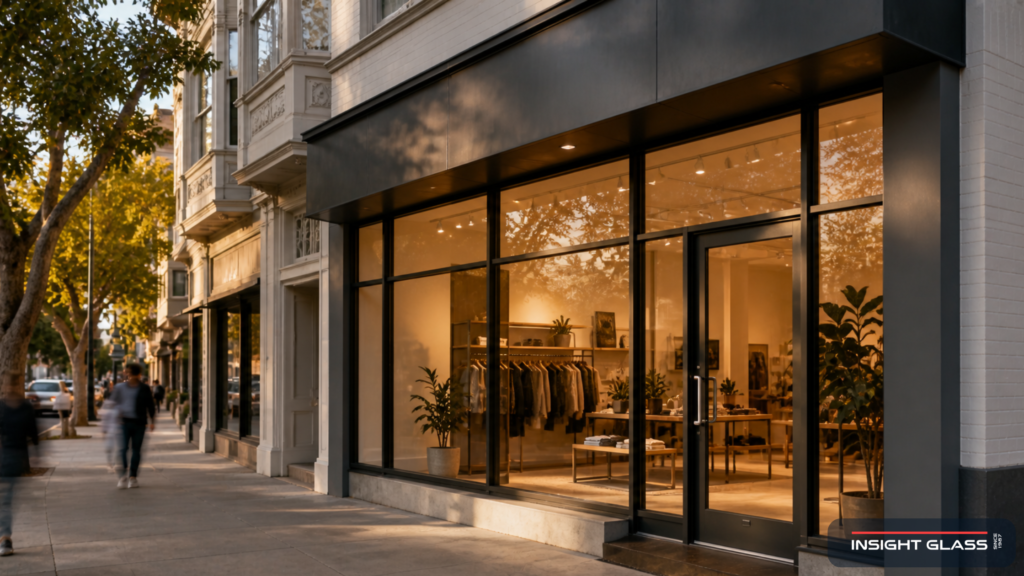
Commercial storefront pricing is one of the most consistently misquoted line items on Bay Area tenant-improvement and replacement budgets. Two contractors can quote the same opening 60 percent apart, and both prices are defensible, because the variables underneath (glass type, frame depth, install timing, ADA adders, permit complexity) move the number more than the headline cost-per-foot.
We’ve installed and replaced storefront systems for retail, restaurants, offices, medical clinics, dispensaries, and fitness flagships across the Bay Area. This guide walks through the 2026 commercial storefront windows cost the way we walk through them on every consultation. By the end, you’ll know the per-foot ranges, the variables that drive the price, and how to read a proposal so you can tell a real number from a vague one.
Table of Contents
1. 2026 Commercial Storefront Cost Ranges
Two pricing models dominate commercial storefront proposals: per linear foot (most common for full replacement or new construction) and per opening (more common for partial replacement or glass-only swaps).
| Per Square Foot Installed (10′ Height Baseline) | 2026 Bay Area Range |
|---|---|
| Standard storefront (thermally broken aluminum, tempered IGU, basic Low-E) | $90–$140 / sq ft |
| Upgraded glass (laminated for security/sound, spectrally selective Low-E, custom finishes) | $130–$180 / sq ft |
| Premium installations (custom anodizing, oversized lites, heavy-duty hardware) | $180–$250 / sq ft |
| Per-Opening Pricing (Repairs / Partial Replacement) | 2026 Range |
|---|---|
| Single tempered IGU swap in existing frame (8′ × 4′ lite) | $1,200–$2,800 |
| Single laminated security IGU swap | $2,000–$4,500 |
| Single 8′ × 9′ storefront opening with new aluminum frame and door | $5,500–$9,500 |
| New Construction Storefront (Tenant Build-Out) | 2026 Range |
|---|---|
| Lower end (no door, simple sill, accessible) | $80–$120 / sq ft |
| Typical retail (one swinging entry door, sidelite, finished interior trim) | $130–$200 / sq ft |
For more granular per-component cost ranges, our “How Much Do Storefront Windows Cost” breakdown breaks down glass-only, frame-only, and labor-only line items separately.
2. Aluminum Storefront vs. Curtain Wall Pricing
The first question on any commercial glazing proposal is whether the system is a storefront or a curtain wall. The two products are different, and the pricing reflects it.
Aluminum Storefront
- Non-load-bearing exterior glazing.
- Frame depth 1-3/4″ or 2″.
- Glass held by snap-in stops or pressure plates.
- Right system for most retail, restaurant, dispensary, ground-floor office.
- Rated for ground-floor or low-rise up to ~10 feet tall.
Curtain Wall
- Hangs off the building structure rather than sitting on a floor sill.
- Frame depth 4-1/2″ to 6″ or deeper.
- Spans multi-story heights and supports larger glass lites (12’+).
- Right system for office towers, mid-rise residential, multi-floor glazing.
- Engineered for wind, seismic drift, and building movement.
For the deeper product overview, see our commercial storefront glass windows guide.
3. Glass Type Cost Impact
Glass selection drives a meaningful share of total project cost. Approximate cost ranges, supplied and installed, in 2026 Bay Area pricing:
| Glass Type | Cost Per Sq Ft | When It’s Used |
|---|---|---|
| Annealed | $20–$40 | Cheapest option, but rarely used in modern commercial storefronts because building code requires safety glazing at most hazardous locations. |
| Tempered | $30–$60 | ~4× stronger than annealed; crumbles into small pieces. Required at doors, sidelites within 24″ of doors, glazing under 18″ from floor. Default for most storefronts. |
| Laminated | $50–$100 | Two glass plies bonded around a polymer interlayer. Holds together when broken. Used for security (cash businesses, dispensaries, jewelry, late-night retail), sound control, and code-required impact-rated locations. |
| IGU construction (over single-pane) | +$20–$40 | Standard for energy-code-compliant commercial storefront. Typical 1″ IGU contains two lites (often one tempered, one annealed or both tempered) with a sealed argon-filled space. |
| Low-E coating | +$5–$15 | Required on most Bay Area commercial projects under California energy code. Standard solar control for coastal/mid-bay zones; spectrally selective for inland Climate Zone 12 (Concord, Livermore, Antioch, San Jose, Pleasanton). |
| Tinted glass | +$5–$20 | Privacy or aesthetic. Minimal premium. |
| Spandrel glass | $30–$80 | Opaque sections behind structure or floor lines. |
| Bird-safe glass | +$15–$40 | Frit pattern or UV coating. Increasingly required by SF and other Bay Area cities, particularly on hotels, offices, and large mixed-use. |
Have a commercial storefront project to scope? We walk every opening, measure for ADA and seismic, and produce itemized proposals so business owners can compare apples to apples.
Call 707-746-65714. Replacement vs. New Install Pricing
Commercial storefront pricing differs meaningfully between like-for-like replacement and new construction installation.
| Project Type | 2026 Pricing | What It Covers |
|---|---|---|
| Glass-only replacement | $30–$80 / sq ft + $200–$500 labor / opening | Frame stays; glass and gaskets replaced. Common for single damaged lites (vandalism, accident) when surrounding system is sound. |
| Full-frame replacement | $90–$180 / sq ft installed | New aluminum framing, new glass, new sealant, new flashing. Existing exterior cladding usually stays unless deterioration requires replacement. |
| New construction storefront | $80–$200 / sq ft installed | Counterintuitively sometimes cheaper per sq ft than replacement — no demolition or working around existing finishes. Requires coordinating with the broader tenant build-out. |
| Mixed/partial replacement | Varies with scope | Replacing only failed sections of an existing storefront. Often used on historic buildings or partial damage that doesn’t justify full system replacement. |
For a broader context on commercial replacement specifically, see our commercial window replacement cost guide.
5. After-Hours / Occupied-Business Install Premium
Commercial storefront installations for existing operating businesses introduce a cost variable that residential projects don’t face: when the work is done.
| Install Window | Labor Premium | Typical Use Case |
|---|---|---|
| Standard daytime (M–F, business closed) | Baseline | Most efficient labor rate. |
| After-hours weeknight (5pm–midnight) | +15–30% | Retail businesses that can’t close during business hours. |
| Weekend (Sat, Sun closed) | +20–40% | Restaurants and retail that close two days per week. |
| Overnight (10pm–6am) | +40–60% | 24-hour retail, gas stations, healthcare, grocery. |
| Holiday or Sunday | +50–80% | If available; some jurisdictions limit construction hours regardless of business preference. |
6. Bay Area Permitting and ADA Cost Adders
Commercial storefront permits and code compliance add costs beyond the glazing itself. The most common Bay Area adders:
| Adder | Cost Impact | When It Applies |
|---|---|---|
| Building permit fees | $500–$3,000 | SF DBI runs the highest; East Bay (Oakland, Berkeley, Walnut Creek, Concord) lower. Plan check sometimes itemized at $500–$2,000. |
| ADA-compliant entry door | +$2,000–$6,000 / door | Existing entry doesn’t meet current ADA (clear width, threshold height, opening force, hardware location). Replacement triggers upgrade. |
| Threshold modifications | $300–$1,500 / opening | Existing threshold exceeds 1/2″ or isn’t beveled correctly. Replacement requires lowering and beveling. |
| Seismic anchorage engineering | $1,500–$5,000 + hardware premium | California requires storefront systems to accommodate seismic drift. New installs or any change to structural attachment trigger structural review. |
| SF DBI plan-check premium | +4–8 weeks; expediter $1,500–$5,000 | Slower but more thorough than most jurisdictions. Expediter cuts timeline meaningfully for projects that need to move. |
| Historic district review | +4–8 weeks | SF North Beach, Hayes Valley, Mission, and Berkeley historic districts may require design review on visible storefront changes. |
| Title 24 nonresidential (CF-1NR) | Usually included | Required for any commercial project. Verify on the proposal. |
| Bird-safe glass requirements | +$15–$40 / sq ft of glass | SF and several Bay Area cities now require bird-safe glazing on certain commercial projects (hotels, offices, larger mixed-use spans). |
7. Sample Project Pricing
To make the pricing concrete, three real-life Bay Area commercial scenarios:
Small Boutique Retail Storefront Replacement
- Size: 10′ × 9′ storefront — two fixed lites and a single swinging entry door
- System: Existing aluminum frame, like-for-like replacement
- Spec: Mid-grade aluminum, tempered IGU with standard Low-E, brushed entry hardware
- Code: ADA-compliant new entry door (existing was non-compliant)
- Schedule: Standard daytime install, 2 days
- Permit: Berkeley city permit, plan check via OTC
Mid-Size Restaurant Storefront
- Size: 24 linear feet of 10′ tall storefront, two entry doors, two fixed lites between
- System: New aluminum framing with thermally broken profiles (existing was not thermally broken)
- Glass: Laminated IGU (busy College Avenue street noise) with spectrally selective Low-E
- Finish: Custom black anodized
- Schedule: After-hours install (Sunday + Monday closure)
- Permit: Oakland city permit, structural engineering for new framing anchorage
Large Office Lobby Replacement
- Size: 42 linear feet of 12′ tall storefront, three entry doors, security glass throughout
- System: Full-frame replacement, premium aluminum with custom dark bronze anodizing
- Glass: Laminated security IGU on all openings (cash management tenant in building); spectrally selective Low-E for cooling load (south-facing elevation)
- Schedule: Daytime install with weekend supplemental work
- Permit: Walnut Creek permit, full structural engineering, ADA review on all three doors
The variance across these scenarios isn’t unusual. Commercial storefront pricing spans a wide range, and locating your project on the band requires honestly walking through size, glass type, install timing, and code adders. For a broader overview of our service, see our storefront windows service page.
Commercial Storefront Window Costs: Building the Right Project Budget
Commercial storefront window costs in the 2026 Bay Area span a 5x to 10x range, from smallest tempered IGU swap to the largest custom curtain wall. The variables that move the number aren’t the headline cost-per-foot, but the underlying choices: aluminum storefront vs. curtain wall, glass type, replacement vs. new construction, after-hours timing, ADA upgrades, and Bay Area permit complexity. The right budget for your project is built by working through each variable specifically, rather than starting with a generic per-foot multiplier.
If you’d like a real proposal for your Bay Area commercial storefront project, we provide free site walk-throughs across retail, restaurant, office, medical, and dispensary applications. We measure every opening, identify ADA and seismic considerations, walk through glass package and finish options, flag the permit and after-hours timing trade-offs, and give you a quote that itemizes what’s included. That’s how commercial storefront window costs actually become your project budget: by matching the line items to your specific project, not generalizing across a market.
8. Frequently Asked Questions
Insight Glass — your Bay Area window experts since 1987.
Call 707-746-6571 for a Free Quote!
CONTACT US FOR A FREE ASSESSMENT