“How much does a bay window cost?” is the most common opening question we get on bay window project calls in the Bay Area. The honest answer disappoints many homeowners because there isn’t a single number. A bay window can cost $4,500 installed at the smallest, simplest end of the range, or $58,000 at the most architecturally significant end of a Bay Area restoration project. Both are real prices. Both are defensible.
The size of the range is the first lesson. The right answer for your project depends on the size, style, frame material, installation scenario, and city where your home is located. We’ve walked through enough Bay Area bay window quotes to know which variables matter most. This guide is the FAQ-style version of that conversation, answering the actual question a homeowner is asking when they Google “how much is a bay window.”
Table of Contents
1. Quick Answer: 2026 Average Installed Bay Window Cost in the Bay Area
The short version, by typical project type:
Installed Bay Window Cost by Project Type
- Small 3-lite canted bay (6 ft wide), vinyl mid-grade, like-for-like: $4,500 to $7,500 installed.
- Medium 4-lite canted bay (8 ft wide), vinyl mid-grade, like-for-like: $7,500 to $12,000 installed.
- Large 5-lite canted bay (10 ft wide), vinyl mid-grade: $11,000 to $17,500 installed.
- Premium fiberglass or wood-clad on architecturally significant homes: $25,000 to $50,000+.
- Restoration-quality bow window with TDL muntins on historic homes: $40,000 to $70,000+.
Almost everything below explains why the range is wide and how to locate your specific project within it.
2. What You’re Actually Paying For (Window + Framing + Roof + Finish)
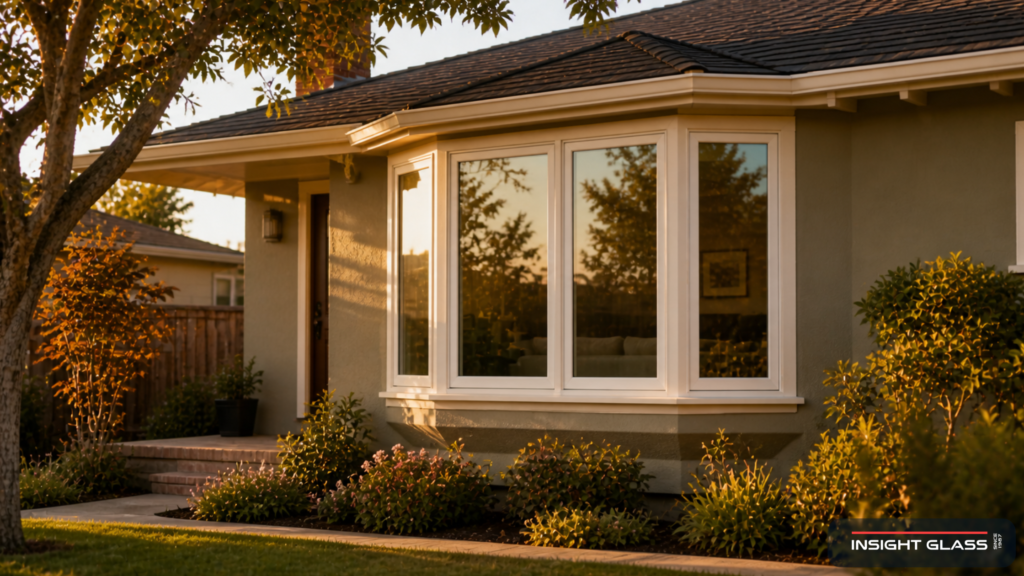
A bay window is not a single window. It’s an assembly of three to five separate window units joined at angles, supported by a structural framing system, topped by a small custom roof, and finished with interior and exterior trim. The total cost stacks across these layers:
Add those layers together, and you get the installed cost band: $4,800 at the low end to $20,000+ at the high end. For the deeper material-by-material breakdown, see our bay window installation cost guide.
3. Cost by Size and Style (3-Lite vs. 4-Lite vs. 5-Lite, Oriel vs. Box)
Two variables drive most of the price variance: the lite count (size of the bay) and the style (geometry).
| Lite Count & Width | Installed Range |
|---|---|
| 3-lite (6 to 7 ft wide) | $4,500–$8,500 |
| 4-lite (8 to 10 ft wide) | $7,500–$12,000 |
| 5-lite (10 to 14 ft wide) | $11,000–$17,500 |
| Custom oversized (12+ ft, 5’6″+ tall) | $16,000–$25,000+ |
| Style | Multiplier | What It Means |
|---|---|---|
| Canted (25–45°) | 1.0× baseline | Most common Bay Area style. |
| Box (90°) | 1.10–1.15× | More framing, more roof area, more flashing complexity. |
| Oriel (cantilevered) | 1.30–1.50× | Requires structural engineering. Adds $2,000–$6,000 in structural cost. |
| Garden (with shelving and overhead glass) | 1.20–1.30× | Most common over kitchen sinks. |
| Bow (curved, 5–7 lites) | 1.40–1.80× | Largest pricing premium of any standard style. |
For 2025-dated pricing references that 2026 builds on with modest inflation, see our cost of bay window replacement 2025 page.
4. Cost by Frame Material
Frame material is the second-biggest non-size driver. The relative multipliers off the vinyl mid-grade baseline:
| Material | Multiplier | When It Fits |
|---|---|---|
| Vinyl (mid-grade) | 1.0× baseline | Bay Area default. Welded corners, multi-chamber profile, compression weatherstripping. Right material for most replacement projects on tract homes. |
| Fiberglass | 1.25–1.50× | Lower thermal expansion than vinyl, slimmer sightlines, durable in coastal exposure, supports dark colors without warping. Right call for higher-end aesthetic projects, west-facing picture windows, inland heat zones. |
| Wood-clad fiberglass | 1.40–1.80× | Wood interior, fiberglass exterior. Common in higher-end Bay Area homes (Pacific Heights, Lafayette, Berkeley Elmwood). |
| Solid wood | 1.60–2.00× | Most expensive, most maintenance-intensive (repaint every 5 to 10 years). Required on Mills Act and historic-resource properties. |
| Aluminum | Rarely used | Higher thermal conductivity makes it a poor energy choice; condensation issues on cold mornings. |
Have a bay window project to budget? We measure on site, walk through the size/style/material tradeoffs, and produce itemized proposals across the cost layers.
Call 707-746-65715. Replacement vs. New Construction Install
How the bay window is installed (replacing an existing assembly vs. creating a new opening) meaningfully affects cost.
| Install Scenario | Cost Impact | What It Covers |
|---|---|---|
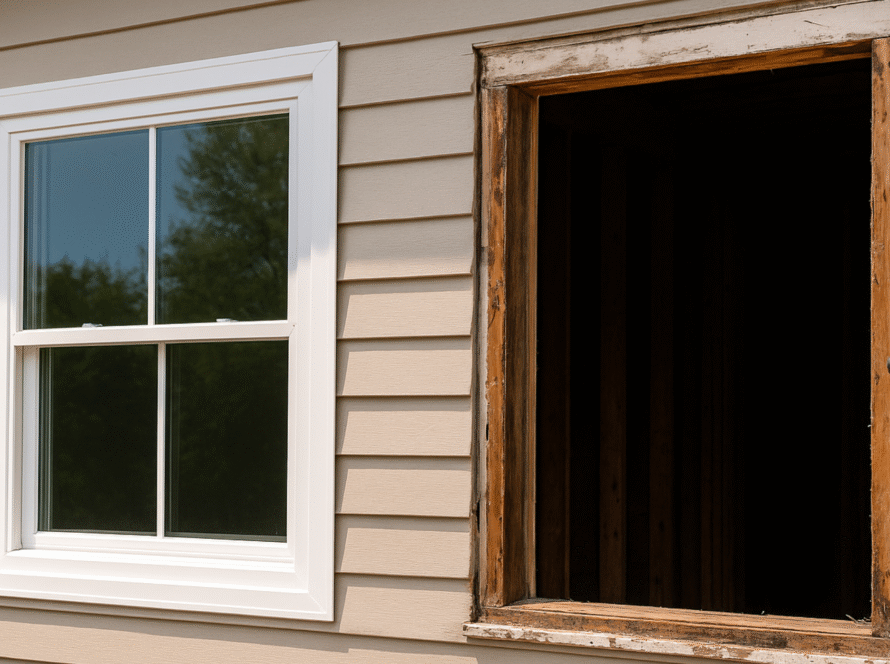
| Like-for-like replacement | 2026 baseline | Existing bay opening, same size. Most cost-effective. Header, rough opening, and often the small roof above can be reused. Demo straightforward. |
| Replacement with structural upgrades | +15–30% | Existing bay, but new size or style. New header, possibly new framing, new roof flashing. |
| New construction | +25–40% | No existing bay opening; creating one in a flat wall. New rough opening cut, structural framing, roof tie-in, exterior siding modifications. Sometimes only marginally more than replacement on a per-sq-ft basis (no demo or debris removal). |
| Cantilevered (oriel) on upper floor | +30–50% | Requires structural engineering, custom cantilever framing, often steel components. |
For SF-specific bay window pricing (which often involves greater structural complexity due to older buildings), see our bay window cost and installation guide for San Francisco.
6. What 5 Real Bay Area Projects Cost (With Breakdown)
To make the pricing concrete, five real-shape Bay Area bay window projects with itemized costs.
1962 Ranch, 3-Lite Canted Vinyl, Like-for-Like Replacement
- Window units (3 lites) $2,800
- Structural and framing $1,200
- Roof tie-in (reused existing) $400
- Install labor (2 days) $1,200
- Interior and exterior trim, sealant $600
- Permit, dump, walk-through $700
1985 Home, 4-Lite Canted Fiberglass, Replacing Failed Original
- Window units (4 lites, fiberglass) $5,200
- Structural header upgrade $1,800
- Roof flashing rebuild $1,500
- Install labor (3 days) $2,100
- Interior trim and casing $900
- Exterior paint match and trim $700
- Permit, dump, Title 24 documentation $900
1953 Mid-Century, 5-Lite Canted Vinyl with Custom Interior Seat
- Window units (5 lites, vinyl) $5,800
- Structural framing (existing opening, no upgrade) $1,200
- Roof flashing repair $1,000
- Install labor (3 days) $2,100
- Custom interior built-in seat with storage $3,200
- Interior and exterior trim $1,200
- Permit, dump, walk-through $800
For more on Burlingame-specific bay window context, see our bay window installation cost Burlingame guide.
1929 Craftsman, 4-Lite Canted Wood-Clad with SDL Muntins, RRP Handling
- Window units (4 lites, wood-clad fiberglass with SDL) $11,500
- Structural framing (replacing rotted original sill) $3,500
- Roof flashing rebuild $2,200
- Install labor (5 days, careful carpentry) $4,500
- RRP-certified lead-safe handling $1,200
- Period-correct interior trim restoration $2,800
- Exterior trim and paint match $1,400
- Permit, dump, walk-through, historic notes $1,200
For Alameda-specific bay window pricing details, see our bay window installation cost Alameda guide.
1907 Edwardian, 5-Lite Bow Window with TDL Muntins, Full Restoration
- Window units (5 lites, solid wood with TDL) $24,000
- Structural framing (engineering required for cantilever) $5,500
- Custom curved roof rebuild $4,800
- Install labor (8 days, restoration carpentry) $7,500
- Period-correct interior trim and finishing $5,200
- Exterior trim, flashing, paint to historic profile $3,200
- SF DBI permit, plan check, Title 24, soft costs $2,800
The variance from $6,900 to $53,000 across these five projects covers the realistic range of what “bay window cost” actually means in the 2026 Bay Area. Locating your specific project within this range requires matching the size, style, material, installation scenario, and home era honestly.
7. Common Cost Surprises
Bay window projects routinely produce cost surprises that aren’t reflected in the initial quote. The most common:
| Cost Surprise | Typical Adder | When It Hits |
|---|---|---|
| Hidden rot in original framing | $2,000–$8,000 | Old bay sills are rot-prone from years of failed flashing. Often invisible until demo. |
| Lead and asbestos remediation (pre-1978 homes) | $300–$3,000 | Depends on test results. Lead-safe RRP-certified handling required by federal law. |
| Custom interior built-in seating | $1,500–$5,000 | Most contractors don’t include this in the base quote unless explicitly scoped. |
| Roof tie-in repairs from old leaks | $1,500–$5,000 | Failing flashing has reached framing or interior; needs broader fix than just the bay. |
| Code upgrades during install | $300–$1,500 | Tempered glass at hazardous locations (often missed on pre-1990 bays). Egress upsizing on bedroom bays. |
| Custom exterior paint matching | $400–$1,200 | Bay’s exterior trim doesn’t match the rest of the home’s paint scheme. |
| HOA review fees and timeline cost | $0–$500 + 4–8 weeks | HOAs in Walnut Creek, Lafayette, Pleasanton are common review triggers. |
| Permit timeline soft cost | 6–10 weeks added (SF DBI) | Carrying cost (storage, scheduling friction, lost use of room) is real even if not on the line item. |
| After-hours work for occupied homes | +15–30% on labor | When the install must happen on weekends or evenings to accommodate occupied living. |
Bay Window Cost in 2026: What Your Project Will Actually Run
Bay window cost is one of the harder Bay Area home improvement questions to answer with a single number, and the honest answer is that the right number for your project depends on five variables: size, style, frame material, install scenario, and home era. The five real projects in Section 6 cover a realistic range from $6,900 (a small Concord ranch like-for-like) to $53,000 (an SF Edwardian historic restoration). Your project will land somewhere on that range, and finding it requires walking through the variables specific to your home.
If you’d like a real assessment for your bay window project, we provide free Bay Area walk-throughs. We measure the existing opening, identify the structural condition, walk through size and style options, flag the cost surprises that apply to your specific home, and give you an itemized quote that breaks the cost into the layers in Section 2. That’s how bay window cost actually becomes your project total: by matching the right combination of size, material, style, and install approach to your specific Bay Area home.
8. Frequently Asked Questions
Insight Glass — your Bay Area window experts since 1987.
Call 707-746-6571 for a Free Quote!
CONTACT US FOR A FREE ASSESSMENT