Bay window pricing is one of the hardest estimates to give over the phone. Homeowners ask “how much for a bay window?” the same way they’d ask “how much for a casement?” but a bay window isn’t a single product. It’s an assembly of three to five separate window units, joined at angles, framed into a wall with a custom roof and a structural header, and finished with interior and exterior trim that matches the rest of the project.
The same-width opening can produce a $4,500 bay window or an $18,000 bay window, depending on choices the homeowner doesn’t know they’re making. We’ve installed enough bay windows across Bay Area neighborhoods to know which inputs actually drive the price. This guide walks through what a real bay window cost calculator looks at, gives you the size and style ranges to estimate within, and tells you when the estimate stops being reliable.
Table of Contents
- How Bay Window Pricing Actually Works
- Inputs: Width, Projection Angle, Number of Units, Style
- Pricing Tables by Size (3-Lite, 4-Lite, 5-Lite)
- Style Multipliers (Canted, Box, Oriel, Bow)
- Bay Area Install Cost Adders (Structural, Roof, Headers)
- Bay Window Cost Calculator (Interactive)
- When the Estimate Isn’t Reliable
- Frequently Asked Questions
1. How Bay Window Pricing Actually Works
Bay window pricing builds up in three layers, and a useful calculator separates them.
Window Units
The three to five glass-and-frame units that make up the bay assembly. Scales with width, glass package, and frame material.
Framing & Structural
Structural header, jambs and sill, exterior sheathing modifications, and (for cantilevered styles) engineering and bracket support.
Install Labor & Finish
Crew time, roof construction, exterior trim and flashing, interior trim and casing, paint touch-up, removal, dump fees, and permits.
Add the layers together, and you get a bay window installed cost band that runs from roughly $4,800 at the cheapest end (small 3-lite vinyl, like-for-like replacement, simple roof) to $20,000+ at the most complex (large 5-lite custom oriel, cantilevered, custom framing, custom interior built-in seating).
For a deeper material-by-material breakdown, our bay window installation cost guide with prices by type, size, and material provides unit-level pricing details.
2. Inputs: Width, Projection Angle, Number of Units, Style
A real bay window cost calculator asks for the inputs that actually move the number. Here’s what we ask homeowners to provide before we give a serious estimate.
| Input | Typical Range | Why It Matters |
|---|---|---|
| Total width | 6 to 14 feet | Wall-to-wall across the bay opening. Drives unit count and framing complexity. |
| Projection depth & angle | 14 to 24 inches; 25, 30, 45, or 90 degrees | Standard angles are 25/30/45 for canted, 90 for box, curved for bow. |
| Number of lites | 3, 4, or 5 (bow uses 5–7) | 3-lite is the smallest. Bow bays use a curved arc. |
| Operability | Fixed center / casement / double-hung | Operating side lites add $200–$500 per side. |
| Style | Canted, box, oriel, garden, or bow | Single biggest non-size driver of price (see Section 4). |
| Frame material | Vinyl baseline, fiberglass, wood-clad, wood | Fiberglass adds 25–50%; wood-clad adds 40–80%. |
| Glass package | Double-pane Low-E baseline | Spectrally selective Low-E adds 10–20%; triple-pane adds 25–40%. |
3. Pricing Tables by Size (3-Lite, 4-Lite, 5-Lite)
For mid-grade vinyl frames with double-pane solar control Low-E in a typical Bay Area replacement project, 2026 installed pricing falls into the following bands by size.
| Bay Configuration | Width | Installed Price (Mid-Grade Vinyl) |
|---|---|---|
| 3-lite small canted | 6 ft | $4,500–$7,000 |
| 3-lite medium canted | 6.5–7 ft | $5,500–$8,500 |
| 4-lite standard canted | 8–10 ft | $7,000–$11,500 |
| 4-lite box variant | 8–10 ft | +10 to 15% over canted |
| 5-lite standard canted | 10–14 ft | $10,500–$16,000 |
| 5-lite bow (curved) | 10–14 ft | $14,000–$22,000+ |
For San Francisco-specific pricing, our bay window cost installation San Francisco page goes into more detail on the city’s labor and permit premiums.
Have a bay opening you’d like priced? We measure on site, check the structural condition, and quote a firm number — not a calculator estimate.
Call 707-746-65714. Style Multipliers (Canted, Box, Oriel, Bow)
The bay style is the single biggest non-size driver of price. Same width, same lite count, same materials, four different styles can produce four different totals.
| Style | Multiplier | What It Is |
|---|---|---|
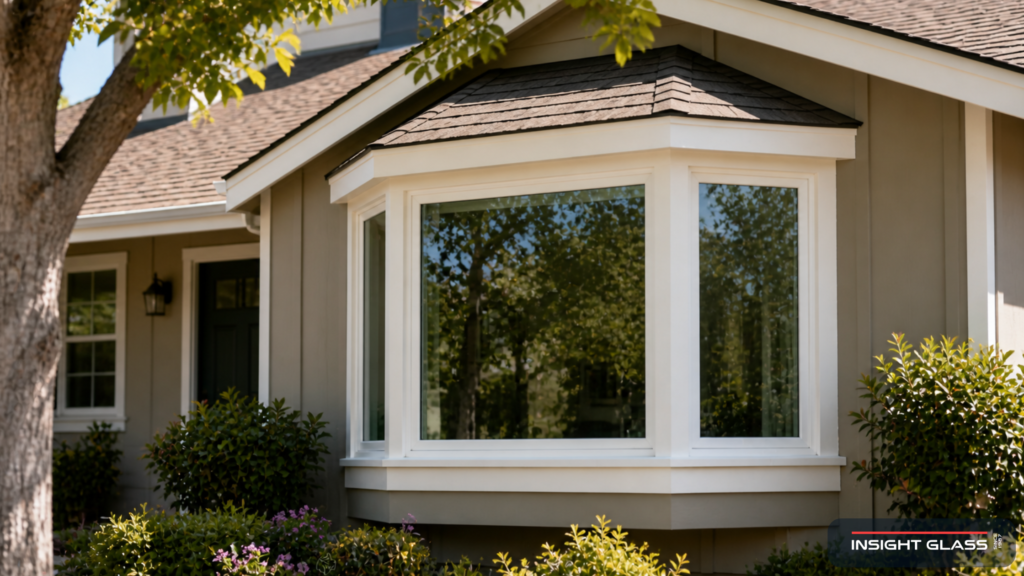
| Canted (25–45 degree angles) | 1.0× baseline | Most common. Side lites angle outward from the center; the assembly looks like a stretched hexagon from above. |
| Box (90 degree angles) | +10 to 15% | Side lites perpendicular to the wall, creating a rectangular projection. More framing, larger roof area. |
| Oriel (cantilevered, no ground-floor support) | +30 to 50% (~$2,000–$6,000) | Bay projects from a wall above the ground floor. Requires structural engineering and architectural review. |
| Garden (small, projecting, with shelves and skylight) | +15 to 25% | Typically over a kitchen sink. Comes with built-in shelving and a glass roof for plant placement. |
| Bow (curved, 5+ lites in an arc) | +40 to 80% | Continuous curve rather than angled segments. More glass units, custom curved interior trim. |
For a refresh on a breakdown specific to bay window replacement, our cost of bay window replacement 2025 page covers the prior-year ranges that 2026 builds on with modest inflation.
5. Bay Area Install Cost Adders (Structural, Roof, Headers)
The base calculator number assumes a like-for-like replacement in an existing bay opening. Real Bay Area projects often have adders that the simple calculation doesn’t capture.
| Adder | Cost Impact | When It Applies |
|---|---|---|
| Structural header replacement | $1,500–$4,000 | Existing opening lacks adequate header, or new bay is heavier than original. Includes engineering, materials, labor. |
| Roof modification | $1,500–$5,000 | New bay openings or larger replacements. Like-for-like can sometimes reuse the existing roof. |
| Cantilever framing (oriel) | $2,000–$6,000 | Upper-floor bay without ground-floor support. Engineering plus cantilever framing. |
| Permit fees | $200–$800 | Bay Area cities. SF DBI runs higher and slower than most East Bay jurisdictions. |
| Title 24 (CF1R) documentation | Usually included | Verify on the quote. Required by California energy code. |
| Lead remediation (pre-1978) | $300–$1,500 | RRP-certified handling for any work disturbing paint. |
| Asbestos remediation (pre-1978) | $500–$3,000 | Suspected asbestos in caulking and siding. Testing plus abatement. |
| Custom interior trim & window seat | $1,500–$5,000 | Built-in window seat with storage. Many projects include this as a major design feature. |
| Hillside or upper-floor access | +15 to 25% on labor | Hillside lots or above-first-floor work. Scaffold and access labor. |
6. Bay Window Cost Calculator
A useful bay window cost calculator collects the inputs from Section 2 and returns three numbers: a low-end estimate (best-case, like-for-like, vinyl, simple roof), a mid-range estimate (typical project, mid-grade specs, standard adders), and a high-end estimate (custom or worst-case scenario, premium specs, full structural work). It also flags whether the project likely needs structural engineering review, historic-resource review, or after-hours work.
Bay Window Cost Calculator
Estimate your 2026 Bay Area installed price. Returns three bands and likely adders.
Your Estimated 2026 Installed Price
The calculator returns three estimates and a list of likely adders. From there, a thorough walk-through and field measurements convert the estimate into a firm proposal.
7. When the Estimate Isn’t Reliable
The calculator provides a reasonable starting point, but the estimate becomes unreliable in several specific scenarios.
- Pre-1978 homes with lead and asbestos risk. Remediation can range from $300 to several thousand. The calculator flags risk; testing prices it.
- Hillside or restricted-access lots. Access labor is site-specific. A bay 30 feet up a Berkeley Hills foundation prices differently from one on a flat Concord lot.
- Hidden rot. Existing bay framing is a common rot location from leaking flashing. Worst-case discoveries add $2,000 to $8,000 in carpentry.
- Historic homes (Mills Act, Article 10). Often require true divided lite muntins, custom curved profiles, or wood-only frames. Adds 30 to 100 percent.
- HOA or city design review. Some Bay Area neighborhoods require review on bay changes — added lead time and sometimes constraints.
- Custom shapes, non-standard angles, or curved bays larger than 14 feet. Fully custom pricing. The calculator is order-of-magnitude only.
- Coastal exposure (Pacifica, Sausalito, Outer Sunset, parts of Oakland near the Bay). Stainless hardware, upgraded sealants, fiberglass over vinyl all add 15 to 25 percent.
In all these cases, the calculator is a starting point, not a quote.
Bay Window Cost Calculator: From Estimate to Real Proposal
A bay window cost calculator answers the right first question (what should I budget for?) but doesn’t answer the second (what will my specific project actually cost?). The gap between a calculator estimate and a firm proposal is where the project’s real variables live: the structural condition behind the existing opening, the roof tie-in to your specific home, the historic-resource considerations on your specific street, and the HOA rules on your specific tract.
If you’re ready to move from estimate to proposal, we provide free Bay Area assessments. We measure every dimension, check the structural condition, identify likely permit and code issues, and give you a firm quote based on your house, not a calculator estimate. That’s how the bay window cost calculator number actually becomes the project total: by walking through the variables the form can’t see.
8. Frequently Asked Questions
Insight Glass — your Bay Area window experts since 1987.
Call 707-746-6571 for a Free Quote!
CONTACT US FOR A FREE ASSESSMENT