



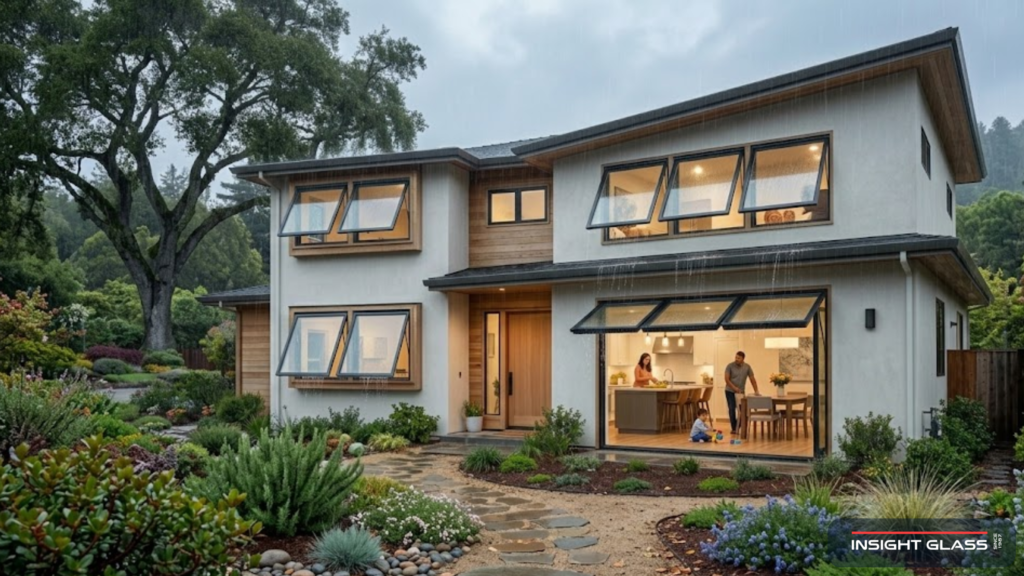
Awning style windows solve a problem that every East Bay family knows well — how to keep fresh air flowing through the house when the weather turns unpredictable. Hayward sits along the eastern shore of the San Francisco Bay, where winter rain showers can arrive without warning and cool marine air drifts inland through the San Mateo Bridge corridor. For families who want ventilation without worrying about rain entering the home or small children accessing low window openings, awning windows offer a design that is both practical and reassuring.
An awning window opens outward from the bottom while remaining hinged at the top. A crank handle controls the opening angle, allowing homeowners to precisely adjust the amount of airflow entering the room. When open, the glass sash tilts away from the wall like a small canopy — shedding rain, deflecting wind, and channeling fresh air into the interior simultaneously. This simple mechanical principle is what makes awning windows uniquely suited to the daily realities of family life in Hayward.
How Awning Windows Protect Against Rain While Ventilating
The defining advantage of awning-style windows is their ability to remain open during light rain without allowing water into the home. Because the sash swings outward at the bottom while the top edge stays sealed against the frame, rainwater runs down the exterior face of the glass and drips off the lower edge — away from the opening rather than into it. This canopy effect means families can leave awning windows cracked open overnight or during the workday without returning to wet sills, damp curtains, or water-damaged flooring.
In Hayward, where annual rainfall averages around fifteen inches and most precipitation falls between November and March, this capability provides months of uninterrupted ventilation that other window styles cannot safely offer. Double-hung and sliding windows must be closed at the first sign of rain. Casement windows catch the wind and direct water sideways into the opening. Only the awning configuration reliably keeps water out while letting air in.
Child Safety and High-Wall Placement
For families with young children, window safety is a constant concern. Awning windows address this concern through placement versatility. Because an awning window opens outward rather than inward and operates through a crank mechanism rather than a lift, it can be installed higher on the wall — well above a child’s reach — while still providing full ventilation and natural light to the room below.
Bathrooms, laundry rooms, and children’s bedrooms benefit particularly from this high-wall placement. A row of awning windows positioned near the ceiling line delivers airflow and daylight without creating an accessible opening that a curious toddler could climb through. The crank handle can be removed or locked in the closed position for additional security when needed.
This placement strategy also enhances privacy. Awning windows mounted above eye level allow light and air to enter without exposing the room’s interior to outside view — a practical consideration for street-facing bedrooms and ground-floor bathrooms in Hayward’s residential neighborhoods, where homes often sit close together.
Pairing Awning Windows With Other Window Types
Awning windows rarely serve as the sole window type in a room. Their real strength emerges when paired with larger fixed or picture windows, creating combinations that deliver both views and ventilation. A common and effective configuration places a large fixed pane at eye level for an unobstructed view, with one or two awning windows stacked above or below to provide operable airflow.
In Hayward kitchens, an awning window installed above the countertop and sink area provides ventilation for cooking steam and moisture without interfering with counter space or cabinetry. The outward swing of the sash clears the work area entirely, and the crank mechanism allows one-handed operation — a practical detail when the other hand is occupied with cooking or dishwashing.
Living rooms and family rooms benefit from the picture-plus-awning combination. The fixed center pane maximizes the view and natural light, while the flanking awning windows open and close to manage airflow based on weather conditions. This approach gives families the brightness of a large window wall with the ventilation flexibility of operable units — without sacrificing the clean visual lines that make a room feel open and modern.
Energy Efficient Performance When Closed
Awning style windows are among the most energy-efficient operable window types available. When closed, the sash presses firmly against the frame from the outside, with the window’s own weight and the compression of the weatherstripping creating an exceptionally tight seal. This operating principle — often compared to how a refrigerator door seals — minimizes air leakage more effectively than the sliding contact points found in double-hung or horizontal-slider designs.
For Hayward families managing energy costs, this seal quality translates to lower heating bills during the cool, damp winter months and reduced cooling costs during the warmer summer period when inland East Bay temperatures climb into the eighties. Dual-pane insulated glass with Low-E coatings and argon gas fill further enhances thermal performance, meeting California Title 24 energy requirements while keeping interiors comfortable year-round.
The combination of tight sealing and insulated glass also reduces exterior noise — a meaningful benefit for Hayward homes near the BART corridor, Interstate 880, or the industrial areas along the western edge of the city. Families notice the difference immediately when replacing older single-pane awning windows or converting from less-tightly sealed window types.
Sizing Considerations and Material Options
Awning windows are typically wider than they are tall, which distinguishes them visually from casement and double-hung styles. Standard sizes range from approximately 24 inches wide by 18 inches tall to 48 inches wide by 36 inches tall. Custom sizes accommodate non-standard openings common in Hayward’s diverse housing stock, ranging from 1950s tract homes to modern infill construction.
Frame materials include vinyl, fiberglass, wood, and aluminum — each with distinct advantages. Vinyl delivers the best value with zero maintenance requirements and solid thermal performance. Fiberglass provides superior structural rigidity for larger units. Wood offers warmth and character for period-appropriate installations. Aluminum suits contemporary aesthetics where narrow frame profiles and maximum glass area are priorities.
Cost Expectations for Hayward Homeowners
Awning window replacement typically costs between $400 and $1,000 per window installed, depending on size, frame material, and glass specifications. High-wall installations may require slightly higher labor costs due to access considerations. For a typical Hayward family home upgrading six to ten awning windows, the total project investment ranges from $2,400 to $10,000.
Insight Glass helps Hayward families select awning window configurations that balance ventilation, safety, energy performance, and budget — ensuring every installation delivers practical daily value for East Bay living.
Since 1987, Insight Glass has provided top-quality windows replacement or installation in the Bay Area.
Call 707-746-6571 for Expert Installation!
CONTACT US TO GET A FREE ESTIMATE!Disclaimer: This article is for informational purposes only. Window requirements vary by property and project scope. Always consult your local building department and a qualified professional for guidance specific to your home.

