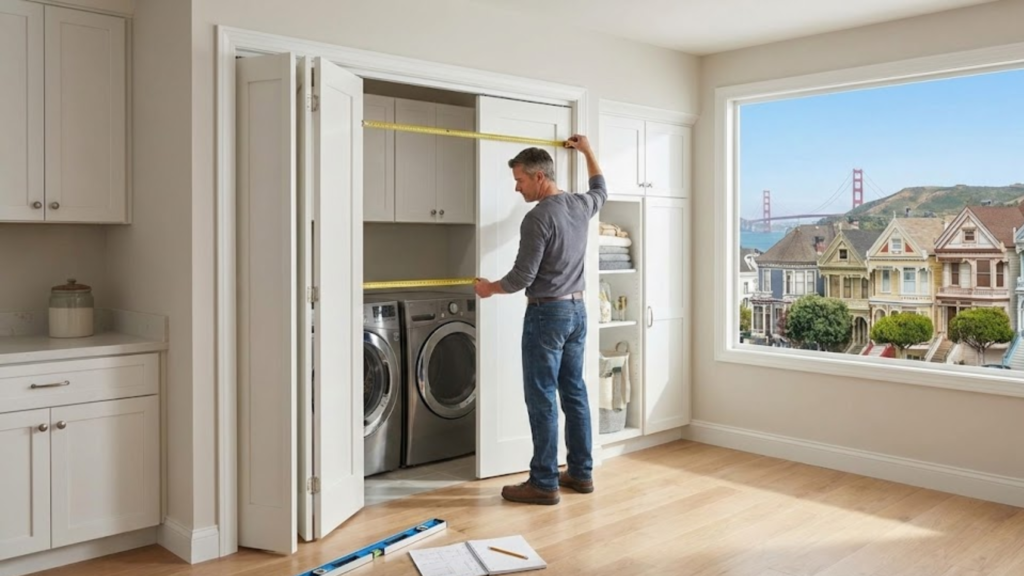
Knowing how to measure for bifold doors correctly prevents costly mistakes—follow these simple steps to get accurate measurements for your closet or laundry room doors.
If you’re wondering how to measure for bifold doors, you’re not alone—it’s one of the most common questions Bay Area homeowners ask before tackling closet or laundry room renovations. Installing bifold doors offers a great space-saving solution, but a single measuring mistake can lead to doors that drag, won’t close properly, or fall out of their tracks. Getting the measurements right the first time saves you from returns, reinstallation headaches, and wasted money.
Here’s the golden rule: Always measure the width and height at three different points—top, middle, and bottom for width, and left, center, and right for height. Record the smallest measurement from each set. Why? It’s much easier to fill a small gap with shims than to cut down a door that’s too large. Standard bifold doors typically require a rough opening about 1/2 inch to 1 inch larger than the door size to accommodate the track hardware and pivot mechanisms.
This guide covers everything you need: the right tools, how to find your rough opening dimensions, and how to calculate the correct door size to order for your Bay Area home.
Tools You Will Need
Before you start measuring, gather these essential tools to ensure accuracy.
A steel tape measure is non-negotiable. Avoid fabric measuring tapes as they stretch over time and give inaccurate readings. A 25-foot steel tape measure works perfectly for most residential door openings.
A step ladder helps you reach the top header accurately. Trying to measure overhead while standing on your toes introduces errors. Use a stable ladder for precise top measurements.
Paper and pencil might seem old-fashioned, but drawing a simple diagram of your opening and recording measurements prevents confusion. Don’t rely on memory when you’re dealing with multiple measurements at different points.
A level checks whether your floor or top jamb runs true. Uneven surfaces affect how your bifold doors hang and operate. Even in newer Bay Area homes, settling can create slight irregularities.
Step 1: Measure the Opening Width
Start by measuring the horizontal distance between the left and right side jambs—the inside surfaces of the door frame, not the decorative trim on your wall.
Measure at three points:
- Top of the frame where the header meets the side jambs
- Middle of the frame at roughly the center point vertically
- Bottom of the frame where the jambs meet the floor
The critical rule: Write down the smallest of these three measurements. This becomes your “Rough Opening Width.” Why does this matter? If your frame bows inward slightly at the middle—common in older San Francisco homes—using the wider top measurement will result in bifold doors that bind or stick in the center. The doors need to fit through the tightest point.
For example, if your measurements are 36 inches at the top, 35.75 inches in the middle, and 36 inches at the bottom, your rough opening width is 35.75 inches.
Step 2: Measure the Opening Height
Next, measure the vertical distance from the finished floor to the underside of the top header (also called the lintel).
Measure at three points:
- Left side of the opening
- Center of the opening
- Right side of the opening
The rule remains the same: Record the smallest measurement. This accounts for floors that aren’t perfectly level or headers that sag slightly in the middle.
Important tip for renovations: If you plan to add carpet, hardwood, or thick flooring later, measure from the subfloor and note the thickness of your future flooring. Subtract this thickness from your header measurement to ensure the bifold doors won’t drag on the new floor surface. Many Bay Area homeowners upgrading from carpet to hardwood forget this step and end up with doors that scrape.
Standard closet openings typically measure 80 to 82 inches in height, but always verify before assuming.
Step 3: Check for Squareness
Bifold doors rely on tracks running smoothly. If your frame is crooked or out of square, the doors won’t slide properly, no matter how well you measured width and height.
The diagonal test reveals whether your opening is square. Measure diagonally from the top-left corner to the bottom-right corner. Then measure from the top-right corner to the bottom-left corner.
The result: If these two diagonal measurements are within 1/4 inch of each other, your opening is square enough for standard bifold door installation. If they differ by more than 1/4 inch, your opening is out of square. You’ll need to shim the frame or adjust the pivot hardware during installation to compensate.
This issue frequently occurs in older Bay Area Victorian and Edwardian homes, where settling has shifted door frames over the decades. Don’t skip this step—it prevents frustration later.
Calculating the Final Door Size
Understanding how manufacturers size bifold doors helps you order correctly. Most people buy standard sizes, but knowing the relationship between rough opening and actual door dimensions is essential.
Width calculation:
Take your smallest width measurement and subtract 1/2 inch. This gap accommodates the door hardware and allows smooth operation.
Example: If your rough opening measures 36 inches wide, you need bifold doors with an actual size of approximately 35.5 inches. Confusingly, these are sold as “36-inch bifold doors”—the nominal size refers to the rough opening they fit, not the door’s actual dimensions.
Height calculation:
Take your smallest height measurement and subtract 1 to 2 inches, depending on the hardware system. This clearance accommodates the top track and bottom pivot brackets.
Standard bifold doors measure 79 inches tall to fit standard 80-inch rough openings. The gap allows approximately 1/2 inch at the top for the track and 1/2 to 1 inch at the bottom for the pivot hardware and floor clearance.
Custom sizes work for non-standard openings, but they cost significantly more than standard dimensions. If your measurements fall within 1/4 inch of a standard size, adjust your frame rather than ordering custom doors.
Common Bifold Door Measuring Questions
What is the actual size of a 36-inch bifold door?
The actual size is typically 35.5 inches wide and 79 inches tall. Manufacturers intentionally make them smaller than the nominal size to fit into a standard 36-inch-by-80-inch rough opening, with proper clearance for hardware. This confuses many first-time installers who expect the door to measure exactly 36 inches.
Do I measure the trim or the frame?
Always measure the inside of the door jamb—the actual wood or metal frame forming the opening. Never measure the decorative casing or trim installed around the opening. The trim doesn’t represent the opening’s functional dimensions.
How much gap do you need for bifold doors?
You generally need a 1/4-inch gap on each side of the door set (a total of 1/2 inch across the width) and about 1 inch of clearance at the top for the track. The bottom typically requires 1/2 to 1 inch for the pivot bracket and to prevent the door from dragging on carpet or uneven floors.
Getting Your Bifold Doors Right the First Time
Measuring for bifold doors comes down to finding the tightest points in your frame. Measure width and height at three locations each, pick the smallest numbers, and verify that your opening is reasonably square using the diagonal test. These simple steps prevent the frustration of ordering the wrong-sized doors.
Once you have your rough opening numbers, check a standard bifold door sizing chart. Most closet openings in Bay Area homes use standard dimensions: 24-inch, 30-inch, 36-inch, or 48-inch widths with 79-inch or 96-inch heights. Matching standard sizes saves money and ensures immediate availability.
Bay Area homeowners planning bifold door installations can rely on Insight Glass for professional measurement and installation services. Our experienced team handles everything from accurate measurements and accounting for out-of-square openings to expert installation, ensuring smooth operation. Whether you’re updating closet doors in a San Francisco Victorian or installing new laundry room doors in a South Bay home, we bring the precision and expertise your project deserves. As a trusted bifold doors installation contractor, we guarantee proper fit and function. Contact Insight Glass today for a free consultation and discover why Bay Area residents choose our professional bifold door services.
Since 1987, Insight Glass has provided top-quality customized bifold doors installation in the Bay Area.
Call 707-746-6571 for Expert Installation!
CONTACT US TO GET A FREE ESTIMATE!