Understanding how to get a bird to stop pecking your window requires identifying the reason for the behavior. Bay Area homeowners can use several effective methods to end persistent pecking without harming birds or compromising window aesthetics.
Why Birds Peck at Windows
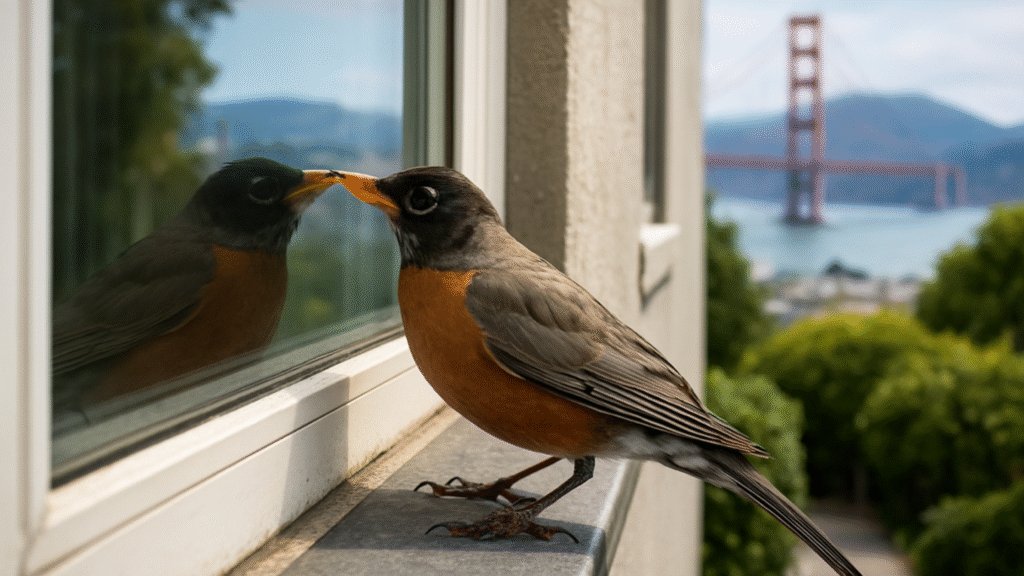
How to get a bird to stop pecking your window starts with understanding the behavior. Birds don’t peck windows randomly—they’re almost always attacking their own reflection, which they perceive as a territorial rival.
This behavior intensifies during breeding season, typically spring through early summer, across the San Francisco Bay Area. Male birds become highly territorial, defending nesting areas against perceived intruders. Your window reflects the bird’s image, triggering aggressive defensive responses.
Common pecking culprits in Bay Area neighborhoods include robins, cardinals, bluebirds, and various finch species. The behavior often begins at dawn and continues intermittently throughout the day, creating frustrating noise for homeowners.
Identifying Territorial Window Pecking
Territorial pecking differs from accidental window strikes. Birds engaged in territorial behavior repeatedly return to the same window, often pecking for minutes at a time before flying away and returning later.
You’ll typically see the same individual bird day after day. The pecking focuses on specific windows—usually those reflecting nearby trees, shrubs, or open sky that the bird considers part of its territory.
The behavior concentrates during specific times. Early morning is a peak time for birds establishing and defending territories. The pecking may decrease midday but resume in the late afternoon.
Quick Solutions to Stop Pecking
Several immediate actions can interrupt the behavior while you implement longer-term solutions for how to get a bird to stop pecking your window.
Break the Reflection
Eliminate or reduce the reflection the bird sees. Soap the outside of the window with a bar of soap, creating a cloudy surface that doesn’t reflect clearly. This temporary solution works quickly but requires reapplication after rain.
Tape strips of paper, ribbon, or painter’s tape to the outside of the window. Space strips vertically 2 to 4 inches apart. This breaks up the reflection enough that the bird no longer sees a clear rival image.
Cover the Window Temporarily
Hang a sheet, blanket, or tarp over the window during peak hours. While not aesthetically pleasing, this eliminates the reflection. Many Bay Area homeowners use this method for a few weeks during the worst of the breeding season.
Close interior blinds or curtains. This reduces reflections but doesn’t eliminate them, so it works better when combined with other methods.
Distract or Deter the Bird
Place a predator decoy near the problem window. Fake owls or hawks sometimes discourage territorial birds, though effectiveness varies. Move the decoy every few days so birds don’t realize it’s harmless.
Hang reflective objects, such as old CDs, aluminum pie pans, or Mylar strips, near the window. Movement and light reflection can deter some birds, though determined individuals may ignore these deterrents.
Long-Term Prevention Methods
Permanent solutions require modifying the window surface to reduce reflections that trigger pecking behavior. These approaches work for both territorial pecking and accidental window strikes.
Apply Window Films or Decals
Specialized window films designed for bird-proofing windows reduce reflections while maintaining visibility from inside. These films create subtle patterns visible to birds but nearly invisible to human eyes.
Decals or tape applied to the outside glass surface break up reflections. For maximum effectiveness, space decals no more than two inches apart horizontally and four inches apart vertically—closer than most people expect.
Install External Screens
Adding screens to the outside of windows eliminates most reflections while allowing light and airflow. The screen mesh breaks up the mirror effect that triggers territorial responses. This solution works particularly well for replacement windows projects where screens can be incorporated into the design.
Modify Landscaping
Sometimes adjusting what the window reflects solves the problem. If your window reflects a tree or shrub, the bird considers prime territory; relocating that plant away from the window’s reflection zone can help.
Trim vegetation near problem windows to reduce territorial associations. Birds defend areas around nesting sites most aggressively, so creating distance between nests and reflective windows reduces conflict.
When to Consider Window Modifications
Angled window installation reduces ground-level reflections that commonly trigger territorial responses. Slightly tilting windows downward reflects the ground rather than the sky and trees, eliminating the illusion of open territory that provokes attacks.
Frosted or textured glass eliminates reflections. While this sacrifices some view clarity, it permanently solves pecking problems for windows where maintaining clear views matters less than ending the behavior.
Understanding how to get a bird to stop pecking your window involves combining immediate deterrents with long-term reflection management. Most Bay Area homeowners find success with simple solutions, such as breaking up reflections with tape or soap. However, persistent cases may benefit from professional bird-safe window treatments that protect both your home and local bird populations.
Since 1987, Insight Glass has provided top-quality windows installation in the Bay Area.
Call 707-746-6571 for Expert Installation!
CONTACT US TO GET A FREE ESTIMATE!