



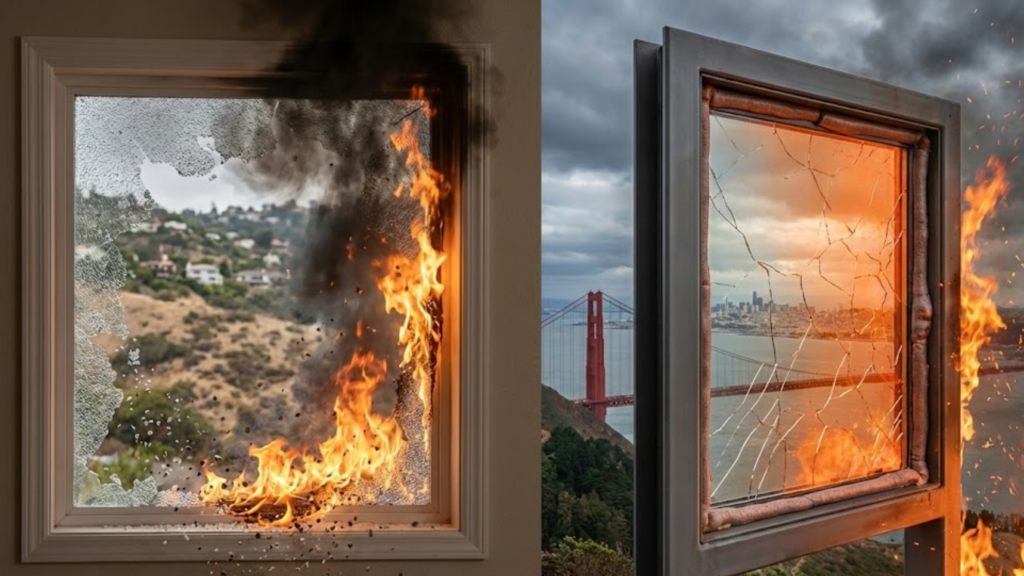
Understanding whether tempered windows are fire rated is critical for Bay Area homeowners and builders—confusing safety glass with fire-rated glass can lead to serious building code violations.
Are tempered windows fire rated? This question comes up constantly among Bay Area homeowners, contractors, and architects planning construction projects. The confusion is understandable—homeowners and builders often assume that because tempered glass is physically more demanding than standard glass, it must also be fireproof or fire-resistant. This dangerous misconception can lead to severe violations of local building codes and failed inspections.
Here’s the straightforward answer: Standard-tempered windows are not fire-rated under building codes. While tempered glass can withstand temperatures up to approximately 500°F—roughly double the tolerance of standard annealed glass—a building fire quickly exceeds 1,600°F, causing even tempered glass to fail rapidly. The type of glass matters enormously when fire protection is required.
There are specialty chemically modified tempered glass products that can achieve a 20-minute fire rating. Still, these remain rare and strictly limited to specific applications like smoke corridors or vision panels in fire doors. These are not the tempered glass windows you’ll find at home improvement stores or installed by typical replacement window experts.
This post clarifies why standard tempered glass windows fail strict fire tests, explains the critical difference between “wildfire-resistant” and “fire-rated,” and identifies what types of windows you actually need for fire code compliance in Bay Area construction projects.
Why Standard Tempered Windows Are Not Fire Rated
Understanding the science behind tempered glass failure in fires explains why it cannot serve as fire-resistant glass despite its enhanced strength.
Thermal shock represents the primary failure mechanism. While tempered glass handles heat better than raw annealed glass due to its internal stress pattern, it cannot survive the rapid, extreme temperature spike characteristic of flashover fires. When fire fully engages a room, temperatures can jump from 300°F to over 1,600°F in seconds.
This sudden temperature differential creates stresses that exceed even tempered glass’s enhanced strength. The glass shatters into thousands of small pebbles—exactly as designed for safety—but this protective feature becomes a liability in fire situations. Once the glass fails, the opening provides no barrier against flames, smoke, or the drawing of combustible materials into the fire.
The hose stream test reveals another critical failure point. To achieve certification as fire-rated glass, the material must pass rigorous standardized fire tests. One crucial component requires the glass to remain intact when sprayed with water while still hot from fire exposure. This simulates firefighters spraying water on a burning building.
Standard tempered glass almost always shatters instantly upon contact with water or heat, due to extreme thermal shock. The rapid cooling creates stresses the glass cannot withstand, causing immediate failure. This consistent failure in the hose stream test disqualifies standard tempered glass from fire-rated certification, regardless of how long it might withstand high heat on its own.
Radiant heat transmission compounds the problem. Even if tempered glass somehow holds its shape for several minutes during fire exposure, it allows dangerous radiant heat to pass directly through to the protected side. This heat transfer can ignite furniture, curtains, or other combustible materials on the supposedly safe side of the window before flames ever breach the opening.
Fire-rated glass must block both flame penetration and heat transmission to earn certification. Standard tempered glass fails on both counts.
The Confusion: Fire-Rated vs. Wildfire-Resistant
Bay Area homeowners face particular confusion due to California’s stringent wildfire codes. Understanding the distinctions among protective standards prevents costly specification errors.
Ember resistance versus fire endurance represents the fundamental difference. In Wildland-Urban Interface (WUI) zones throughout the Bay Area hills, local building codes do require tempered glass windows. However, this requirement doesn’t stem from tempered glass being fire-rated in the traditional sense of withstanding a building fire for 45, 60, or 90 minutes.
The requirement exists because fire-resistant tempered glass resists breakage from wind-blown embers and moderate radiant heat better than standard annealed glass. During wildfires, flying embers—not direct flame contact—cause most home ignitions. Tempered glass can withstand the impact of embers hitting at high velocity and resist cracking from moderate heat exposure without shattering.
Standard annealed glass breaks easily when embers strike it or when exposed to moderate heat, creating openings for embers to enter and ignite interior materials. Tempered glass prevents this specific failure mode.
The critical distinction: A window can be “ignition resistant” (meeting WUI wildfire codes) without being “fire-rated” (able to contain a structural fire for specific durations). These are entirely different performance standards serving different protective purposes. Bay Area residents in fire-prone areas need to understand which standard applies to their particular situation.
Fire-resistant windows designed for WUI zones protect against external wildfire threats. Fire-rated windows help prevent the spread of internal structural fires between rooms or buildings.
When Is Tempered Glass Actually Fire Rated?
Specialty products blur the lines, but they differ substantially from standard tempered glass.
Specialty 20-minute-rated tempered glass is produced through advanced chemical processing that modifies the glass’s thermal properties. These products undergo specialized treatment beyond standard tempering, allowing them to pass fire test protocols for limited durations—typically 20 minutes maximum.
Usage remains restricted. These specialty-resistant tempered glass products typically appear only in door vision lites (the small windows in fire doors) or in specific corridor windows where smoke containment matters more than heat containment. The 20-minute rating provides minimal protection compared to the 45, 60, or 90-minute ratings required for most fire-resistive glass applications.
The system approach remains mandatory. Just as with aluminum frames, you cannot install fire-rated specialty tempered glass into standard vinyl, aluminum, or wood window framing and expect it to provide fire protection. The entire window assembly—glass, frame, seals, and anchors—must be tested together as a complete system.
The frame materials must withstand fire without melting, warping, or failing structurally. Standard residential window frames cannot provide this protection, regardless of what glass you install. A fire-rated window installer uses specialized framing systems designed to work with fire-resistant glass.
Identification: How to Spot Fire-Rated vs. Standard Tempered
Learning to distinguish standard safety glass from fire-rated products prevents dangerous assumptions.
The permanent label provides the definitive answer. Standard tempered glass carries a minor etched marking or “bug stamp” referencing CPSC 16 CFR 1201 (Consumer Product Safety Commission). This indicates compliance with impact safety standards—the glass will break into small, relatively safe pieces rather than large, dangerous shards.
This safety certification has nothing to do with fire protection. It addresses impact resistance and breakage patterns, not heat resistance or fire endurance.
Fire-rated glass displays different markings. Proper fire-rated glass will show permanent etching or labels referencing UL (Underwriters Laboratories), Intertek, or other recognized testing agencies, along with specific duration ratings. You’ll see codes like “D-20” indicating 20-minute door glass, “W-60” indicating 60-minute wall/window glass, or similar designations.
Visual cues offer a preliminary assessment. If the glass looks identical to standard car window glass or patio door glass—clear, relatively thin, in a standard vinyl or aluminum frame—it’s almost certainly safety-rated tempered glass, not fire-rated.
Fire-rated ceramic glass often appears slightly different—sometimes with subtle tinting or visible thickness variations. Fire-resistant glass using intumescent technology may look clearer, but it sits in obviously specialized, heavy-duty frames. Wired glass, an older fire-rated option, shows visible wire mesh embedded in the material.
Common Tempered Glass Fire Questions
Is tempered glass fire-retardant?
No. Tempered glass is non-combustible, meaning it won’t burn or act as fuel for fires. However, it does not retard the spread of fire or block heat transmission effectively enough to be classified as a fire-retardant material. It breaks at relatively low temperatures during a fire, eliminating any protective barrier.
Can I use tempered glass for a 1-hour fire wall?
Absolutely not. For 45, 60, or 90-minute fire ratings required in commercial construction or multi-family buildings, you need specialized fire-rated glass products—typically fire-rated ceramic glass or intumescent glass systems, not tempered glass. Attempting to use standard tempered glass where codes require fire ratings will result in an inspection failure and severe liability.
Does tempered glass break in a fire?
Yes, definitely. Standard tempered glass will shatter into small pebbles at approximately 500-600°F or immediately if hit by water during firefighting operations. This leaves the opening completely unprotected, allowing fire, smoke, and heat to pass freely. The safety feature that makes tempered glass protective in accidents becomes a vulnerability in fires.
Making Informed Fire Safety Decisions
While tempered glass windows offer excellent impact resistance and meet Bay Area WUI wildfire codes, they cannot substitute for certified fire-rated glazing in commercial code applications or locations requiring true fire-rated assemblies.
Understanding what protection you actually need depends on your specific situation. Single-family homes in WUI zones typically need tempered glass for ember resistance. Commercial buildings, multi-family construction, or windows on property lines often require true fire-rated assemblies with ceramic or intumescent glass in steel frames.
If your architect or building inspector specifies “fire-rated windows” on your plans, do not attempt to fulfill this requirement with standard tempered glass. The products are fundamentally different, serving entirely different protective purposes.
For expert guidance on fire-rated window requirements in Bay Area construction projects, consult with Insight Glass. As the best window installation contractor serving San Francisco and surrounding communities, we understand the critical differences between safety glass, wildfire-resistant glazing, and fire-rated assemblies. Whether you’re planning new construction windows installation requiring WUI compliance or commercial projects demanding certified fire-rated systems, our team provides the expertise and proper materials your project needs. Contact Insight Glass today for professional consultation on the right fire-protective windows for your specific Bay Area application.
Since 1987, Insight Glass has provided top-quality windows installation in the Bay Area.
Call 707-746-6571 for Expert Installation!
CONTACT US TO GET A FREE ESTIMATE!
