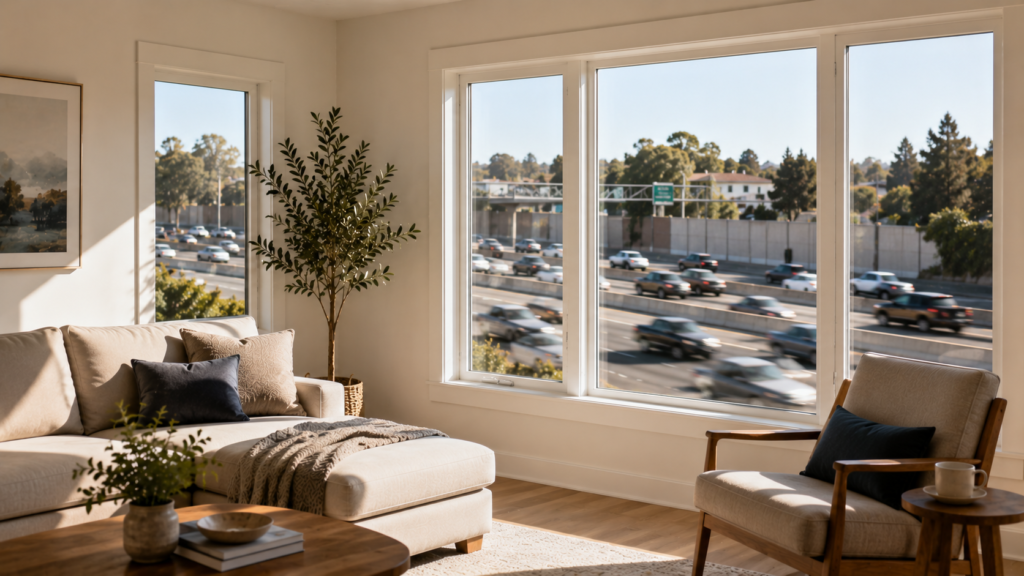
If you live near a freeway, a BART line, or under a flight path into SFO or OAK, you already know that outside noise has a way of finding its way indoors. The good news is that the right window can make a dramatic difference, and the difference comes down to materials and construction rather than marketing labels. This guide breaks down the best windows for noise reduction so you can understand what truly blocks sound, from the glass itself to the frame and seals, and choose a setup that fits your home and your street.
Before we get into specifics, one quick note on terms. When people talk about “soundproof” windows, no window is completely soundproof. What we are really after is meaningful noise reduction, where conversations, traffic rumble, and aircraft become quieter and easier to tune out. With the right combination of glass and framing, a quieter home is very achievable.
Table of Contents
- What Makes a Window Soundproof (STC Ratings Explained)
- Glass Options That Reduce Noise Most Effectively
- Double-Pane vs. Triple-Pane for Noise Reduction
- The Role of Air Gaps and Inert Gas Fills
- Frame Materials and Seals That Block Sound
- Combining Soundproofing With Energy Efficiency
- Best Solutions for Common Bay Area Noise Sources
- Frequently Asked Questions
- Choosing the Best Windows for Noise Reduction for Your Home
What Makes a Window Soundproof (STC Ratings Explained)
Sound travels in waves, and when those waves hit your window, the glass and frame either let them pass through or absorb and reflect them. The denser and less “vibration-friendly” a window is, the more sound it stops.
The industry measures this with the Sound Transmission Class, or STC. STC is a single number that rates how well a window blocks airborne sound across a range of frequencies, with higher numbers indicating better noise reduction.
| Window Type | Typical STC Rating |
|---|---|
| Single-pane window | 26–28 |
| Standard double-pane windows for noise reduction | 28–34 |
| High-performance laminated or specialized systems | 40 or higher |
For a window that feels noticeably quiet, many homeowners aim for an STC in the upper 30s or beyond.
Glass Options That Reduce Noise Most Effectively
The single biggest lever you can pull is the glass. Here are the upgrades that move the needle most.
Laminated Acoustic Glass
The standout. It sandwiches a thin, flexible plastic interlayer between two panes of glass, which absorbs and dampens vibrations before they reach the inside of your home. Especially good at taming low-frequency noise like traffic rumble and trucks, which is exactly the kind of sound that ordinary glass struggles to stop.
Thicker Glass
Mass blocks sound. A heavier pane is harder for sound waves to vibrate, so stepping up from thin builder-grade glass to a thicker pane raises performance.
Asymmetrical (Mixed-Thickness) Glass
One of the smartest tricks in acoustic design. When the two panes are different thicknesses, each resonates at a different frequency. That mismatch breaks up sound waves so they cannot pass through both panes as easily, widening the range of noise the window can block.
Double-Pane vs. Triple-Pane for Noise Reduction
A common question is whether more panes automatically mean less noise. The answer is “sometimes,” and the details matter.
Double-pane windows use two layers of glass separated by a sealed air or gas space, and they are a big jump over single-pane. For many homes, a well-built double-pane unit with laminated and mixed-thickness glass delivers excellent noise reduction without the added weight or cost of a third pane.
Triple-pane windows add a third layer of glass and a second air gap. The extra mass and the additional space can improve sound control, particularly for higher-frequency noise, and triple-pane glass shines for energy efficiency. However, triple-pane units sometimes use three panes of equal thickness with narrow gaps, which is not always the ideal recipe for blocking low-frequency traffic noise. In other words, a thoughtfully designed double-pane window with laminated, asymmetrical glass can outperform a basic triple-pane unit for certain noise problems. If you are weighing the third pane, our guide to triple-pane windows for soundproofing walks through the trade-offs.
The Role of Air Gaps and Inert Gas Fills
The space between panes is not empty filler. It is a working part of the system.
A wider air gap gives sound waves more room to lose energy before they reach the next pane, which is why larger gaps generally improve noise reduction. This is one reason a thicker double-pane unit can rival a thinner triple-pane one.
Many windows also fill that gap with an inert gas, such as argon or krypton, rather than plain air. These gases are denser than air, which slightly slows sound transmission and, more importantly, boosts thermal performance. The acoustic gain from gas fill is modest compared to laminated glass or wider gaps, but it stacks nicely with the other upgrades and improves energy efficiency.
Tired of hearing the freeway from your living room? Insight Glass matches the glass, gap, and frame to your exact noise source — free in-home assessment included.
Call 707-746-6571Frame Materials and Seals That Block Sound
A window is only as quiet as its weakest point, and that point is often the frame and the seals around it. Even premium glass underperforms when sound leaks through gaps at the edges.
For frame material, the goal is rigidity, density, and a tight seal. The options we install and recommend for noise control include:
| Frame Material | Why It Helps Block Sound |
|---|---|
| Vinyl | A solid, budget-friendly choice. Quality vinyl frames have multiple internal chambers that trap air and dampen vibration, and they seal well against drafts and sound. |
| Fiberglass | Strong, stable, and dense, it resists expansion and contraction in the Bay Area’s mix of coastal damp and inland heat, helping seals stay tight over time. |
| Composite | Engineered from a blend of materials, composite frames combine the strength and stability that keep sound and weather out. |
Just as important as the frame is the sealing system. Tight, multi-point weatherstripping and quality seals close the tiny gaps where sound sneaks in. A professional installation matters here, because even the best frame and glass will let noise leak if the unit is not sealed properly to the wall opening. That craftsmanship is a core part of our window replacement services.
Combining Soundproofing With Energy Efficiency
The happy surprise for most homeowners is that the upgrades that block sound also tend to lower energy bills. Laminated glass, multiple panes, inert gas fills, and tight seals all reduce heat transfer while also reducing noise.
That means a window chosen for a quieter home can also qualify as a high-quality, energy-efficient upgrade. Look for ENERGY STAR certification and a strong U-Factor (a measure of how well a window insulates) to confirm the thermal side of the equation. For California homeowners, energy-efficient windows also help with Title 24 compliance, so you are solving two problems with one investment. Curious about pricing for the acoustic features? Our breakdown of soundproof windows cost lays out what drives the numbers.
Best Solutions for Common Bay Area Noise Sources
Different streets call for different setups. Here is how we tend to approach the most common local noise problems.
| Noise Source | Recommended Setup |
|---|---|
| Freeway and arterial traffic (homes near I-80 in Berkeley, the 580 corridor, or busy streets in Oakland and San Jose) | Traffic produces a lot of low-frequency rumble, so prioritize laminated acoustic glass and asymmetrical pane thicknesses, paired with a wide air gap. Check the OITC rating, since it best reflects how a window handles this kind of sound. |
| Transit and rail (BART lines, Caltrain on the Peninsula, light rail) | These combine rumble with sharper mechanical sounds across a wide frequency range. Mixed-thickness laminated glass in a well-sealed vinyl or fiberglass frame handles the spread well. |
| Aircraft (neighborhoods near SFO, OAK, and San Jose Mineta) | Aircraft noise carries strong low frequencies and a wide range overall, so lean on the most robust combination: laminated glass, asymmetrical panes, generous air gaps, and airtight seals. OITC is the rating to scrutinize here. |
Across all three, the pattern is consistent. Laminated, mixed-thickness glass, combined with a dense, well-sealed frame, is the foundation of effective soundproof windows.
Frequently Asked Questions
Choosing the Best Windows for Noise Reduction for Your Home
When you boil it down, the best windows for noise reduction share a clear recipe: laminated acoustic glass, panes of different thicknesses, a wide air gap (often with an inert gas fill), and a dense, tightly sealed frame in vinyl, fiberglass, or composite. Match that setup to your specific noise source, whether it is freeway traffic, BART, or aircraft, and pay attention to STC and OITC ratings so you know what you are buying.
Every home and every street is a little different, which is why a professional assessment makes such a difference. The team at Insight Glass installs and replaces windows across Solano, Contra Costa, Alameda, Marin, San Mateo, Santa Clara, Napa, and Sonoma counties, and we can recommend the exact glass and frame combination that will quiet your home. Ready to turn down the volume? Schedule your free in-home estimate with Insight Glass today, and let us help you find the right windows for a quieter, more comfortable home.
Insight Glass — your Bay Area window experts since 1987.
Call 707-746-6571 for a Free Quote!
CONTACT US FOR A FREE ASSESSMENT