


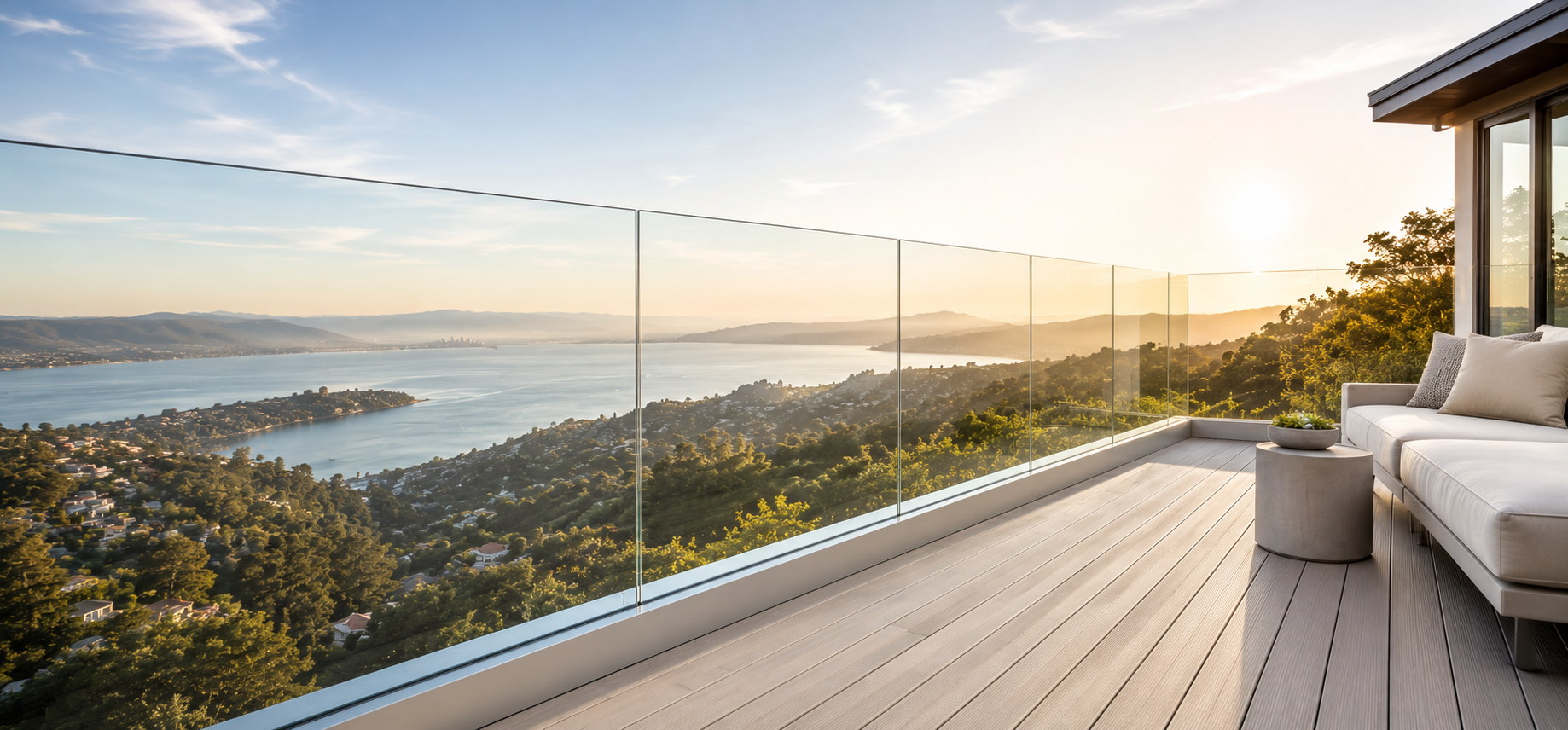
Glass Railings and Glass Guardrails for Bay Area Homes
Frameless, semi-frameless, and post-supported glass railing systems for decks, balconies, stairways, pools, and rooftop terraces. Installed across the Bay Area from $120 per linear foot, typically completed in 3 to 6 weeks from signed contract. Licensed, insured, and installing glass here since 1987.
(707) 746-6571Or call us directly

Where Glass Railings Get Installed
A glass railing, called a glass guardrail on a permit set, is a code-required safety barrier built from tempered or laminated safety glass instead of pickets or cable, held by a base channel, posts, or stainless fittings. It does the same job a metal or cable guard does without taking your view away. These are the six applications we install most often across the Bay Area, and each one asks something different of the system.
Glass Deck Railings
The most requested application we install. On a hillside lot or a water-facing deck, a picket railing cuts the view into vertical slices and a glass deck railing doesn't. The decision that matters here is the mounting: a base shoe anchored into the deck frame gives an uninterrupted run, while standoff fittings give a lighter look with more visible hardware.
Existing decks usually work, but the framing has to carry the anchoring load. Glass systems concentrate more force into fewer points than a picket railing does, so we check the substrate at the estimate, not at install.
Glass Balcony Railings
Second-floor and upper-level balconies, including replacements where an existing guard no longer meets current code. Balconies carry the tightest code scrutiny of any application on this list because the fall height is real, so the engineering and the anchoring detail get looked at closely during inspection.
Wind matters more up here than people expect. A glass balcony railing blocks wind while a picket railing lets it through, which is the reason many exposed Bay Area balconies go to glass in the first place.
Glass Stair Railings
Interior and exterior stairways. A glass stair railing opens up a stairwell and keeps daylight moving through the middle of a house instead of stopping it at the landing, which is why it's the most common interior railing project we take on.
Stairs are the hardest railing to fabricate well. Every panel is cut to the rake of the stair, so measurements have to be exact before anything is tempered. There's no adjusting tempered glass on site.
Pool Enclosures & Fences
Pool barriers follow their own safety rules, separate from standard guard requirements, covering height, gaps, and self-closing gates. We build to the pool code rather than the deck code, and we'll confirm which applies before we quote.
Glass pool fencing lets you keep sightlines to the water, which is the whole point when the barrier exists so a child can't reach the pool unsupervised.
Rooftop Terrace Railings
Roof decks and terraces, where two things need engineering attention at once: wind exposure at height, and anchoring into a roof assembly without compromising the waterproofing below it.
This is the application where we most often coordinate with a roofer or general contractor so the flashing detail and the railing anchor are solved together rather than in sequence.
Patio Windscreens
Glass panels that stop wind without stopping the view. Common on exposed patios near the water and in the hills, where an otherwise usable outdoor space is unusable half the year because of wind.
A windscreen isn't always a guard, so the code path can be different. If the panel is not protecting a drop, the requirements change, and that changes both the glass and the cost.
Glass Railing Systems We Install
The system decides three things at once: how the glass is held, how much hardware you see, and what the job costs per foot. We install all five residential glass railing systems below, and the right one usually comes down to how much hardware you're willing to look at and how long the run is.
| System | How it mounts | View | Relative cost | Best suited to |
|---|---|---|---|---|
| Frameless | Glass carried by a base channel or clamps with no vertical posts | Fully open | Highest | Decks and balconies where the view is the whole point |
| Semi-frameless | Minimal top or side framing with clamps between | Mostly open | Upper middle | A frameless look at a lower cost than true frameless |
| Post-supported | Glass panels set between vertical posts | Segmented | Lowest | Longer runs and budget-conscious projects |
| Base shoe | Continuous aluminum channel anchored to the deck or slab | Fully open | Upper middle | Clean continuous runs, including rooftop terraces |
| Standoff / spigot | Individual stainless fittings holding each panel | Fully open | Upper middle | A lighter, more architectural look than a base shoe |
Want the detail on the two most popular systems? Read our guides to frameless glass railings and semi-frameless glass railings.
Glass and Hardware Options
Most of this gets settled at the estimate with samples in front of you. Here is what we carry so you know the range before we get there.
Glass
Tempered is the baseline. Which one your project needs is partly a code question rather than a style one, and thickness is set by the span and the system. See how thick glass railings need to be.
Hardware Finishes
If you're anywhere near the water, specify marine-grade stainless. Standard stainless pits in salt air within a few years, and the hardware is the part you can't swap out later without pulling the glass.
Glass Railing Cost in the Bay Area
Glass railings are priced per linear foot, installed. Here is the range by system type so you can size a budget before anyone visits.
| System | Installed, per linear foot | What moves the number |
|---|---|---|
| Post-supported | $120 to $200 | Post spacing and finish |
| Semi-frameless | $125 to $250 | Amount of framing and clamp count |
| Standoff / spigot | $175 to $325 | Fitting count and stainless grade |
| Base shoe | $200 to $375 | Run length and anchoring substrate |
| Frameless | $225 to $450 | Glass thickness and panel size |
Five things that change the price
- Glass thickness. Longer spans and taller panels call for thicker glass, and glass is priced by weight.
- Hardware finish. Marine-grade stainless costs more than standard, and it's the right call near the water.
- Site access. Large panels are heavy. A hillside lot or a second-floor balcony with no clear path adds labor.
- Permit and inspection. Requirements vary by jurisdiction across the Bay Area counties.
- Condition of the substrate. A deck or slab that can't take the anchoring load needs work before the railing goes on.
For a full breakdown with worked examples, see what glass railings cost.
Glass, Cable, or Metal Picket?
Most homeowners are choosing between three guard materials. Here is the honest comparison before you commit.
| Glass | Cable | Metal picket | |
|---|---|---|---|
| View | Fully open, no interruption | Open, with horizontal lines across it | Segmented by vertical bars |
| Cost | Highest of the three | Middle | Lowest |
| Maintenance | Regular cleaning to stay clear | Periodic cable tensioning | Lowest upkeep |
| Wind | Blocks wind, which is why it doubles as a windscreen | Passes wind through | Passes wind through |
| Code | Glass type and configuration are regulated | Cable spacing and tension are regulated | Baluster spacing is regulated |
| Best for | Homes where the view or wind protection is the reason for the project | Modern homes wanting openness at a lower cost | Budget projects and traditional exteriors |
The honest downsides of glass railings
We install these for a living and we would still rather you hear this now than after the invoice. Glass is the most expensive of the three guard materials, and it is the only one that looks worse when you skip the upkeep. Every water spot and handprint shows, so a panel that nobody squeegees for a season looks neglected in a way a picket railing never does.
Three more things worth knowing. Tempered glass is cut and treated before it ships, so nothing can be trimmed on site and a measuring error is an expensive one. A solid glass panel catches wind rather than letting it pass, which is exactly why it works as a windscreen, but it also means the anchoring has to carry more load than a picket railing would. And glass is transparent by default, so on a balcony that faces a neighbor you are choosing frosted glass or accepting the sightline.
If any of those matter more to you than the view does, cable or metal picket is the better call, and we will tell you that at the estimate rather than sell you glass.
What California Code Requires
The 2025 California Building Code took effect on January 1, 2026. Code calls these guards, which is why you will see a glass railing described as a glass guardrail on a permit set. These are the five things it governs.
When a guard is required
A guard is required once a walking surface sits more than 30 inches above the surface below.
Guard height and openings
Residential guards must reach 42 inches, and no opening in the guard may pass a 4-inch sphere. Commercial occupancies are held to different figures.
Tempered or laminated
Guard glazing must be safety glass. Where a guard has no continuous top rail, code calls for laminated glass so the panel stays in place if it breaks. This is decided at design, not at install.
Load requirements
The system has to carry a specified distributed load and a concentrated load at the top rail: a 200-pound concentrated load applied outward and downward at any point along the top.
Seismic anchoring
California guards carry seismic loads on top of the standard ones, so the anchor detail and the substrate behind it both matter. This is part of the engineering we submit with the permit.
Pools and permits
Pool barriers follow separate safety rules covering height, gaps, and self-closing gates. Permit requirements vary by jurisdiction across the Bay Area counties.
We handle the permit and inspection process as part of every install, including the engineering the plan check asks for.
Commercial and multifamily buildings have separate guard requirements, load criteria, and submittal steps.
Our Installation Process
Five steps from first call to final inspection. Typical timeline is 3 to 6 weeks from signed contract, with fabrication accounting for most of it.
Free Estimate
We visit the site, measure, check the substrate, and give you a written price.
Design & Engineering
System selection, panel layout, and the engineering the permit requires.
Fabrication
Glass is cut, tempered, and finished to your measurements, then quality checked.
Installation
Anchoring, setting, and glazing, done by our own installers rather than a sub.
Inspection & Warranty
We walk the job with you, handle the inspection, and register the warranty.
Timeline, Upkeep, and Warranty
Three questions we get asked on every estimate, answered before you have to ask them.
How long it takes
Plan on 3 to 6 weeks from signed contract to completed installation. Fabrication is the longest stretch, because tempered glass is cut and treated to your exact measurements and can't be adjusted on site.
Installation itself is usually one to two days for a typical residential run.
Keeping it clear
Glass railings show water spots and handprints more than a picket railing does. Most homeowners squeegee their exterior panels every two to four weeks with a squeegee and a mild glass cleaner, more often near the water.
Skip abrasive pads and ammonia-heavy cleaners on coated glass. Rinse marine-grade stainless hardware with fresh water a few times a year in coastal areas to keep salt from pitting the finish.
What is covered
Every install comes with a written warranty covering the glass, the hardware, and our workmanship. We hand you the terms with the estimate, before you sign anything, rather than after the job is done.
A properly installed glass railing system lasts 20 to 30 years. Most of what shortens that is hardware corroding in salt air, which is why we specify marine-grade stainless near the water.

Why Bay Area Homeowners Choose Insight Glass
Since 1987
Nearly four decades installing glass across the Bay Area, under the same ownership.
Licensed & Insured
CSLB 599566, fully insured, with certificates available on request.
Our Own Installers
The crew that measures your job is the crew that installs it. No subcontracted glazing.
Cities Served
Coverage across Solano, Contra Costa, Alameda, Marin, Napa, San Mateo, and Santa Clara counties.
Glass Railing Installation Across the Bay Area
Headquartered in Benicia and installing across Solano, Contra Costa, Alameda, Marin, Napa, San Mateo, and Santa Clara counties.
What Our Clients Say
"Insight Glass is first class. Site review to assure acurate estimate was scheduled and perfored timely. Pricing was detailed and very competative. Product was delivered as scheduled with special call to address any accomodations for site specific needs. Overall rating 10+."
"Insight Glass Inc. are always very helpful. Great service. They care."
"Insight Glass is a Great shop with Excellent Service & Fast Delivery"
Glass Railing Questions
The questions homeowners ask most often on a railing estimate. If yours isn't here, call (707) 746-6571 and ask.
Installed glass railings run from $120 to $450 per linear foot depending on the system. Post-supported is the least expensive and frameless is the most. Glass thickness, hardware finish, site access, and the condition of the substrate all move the number. See the full cost breakdown.
Cost and cleaning are the two real ones. Glass is the most expensive guard material, and it shows water spots and handprints in a way cable and metal do not, so it needs a squeegee every few weeks to keep looking right. Beyond that: tempered glass can't be adjusted on site, a solid panel catches wind so the anchoring works harder, and it's transparent unless you specify frosted.
It's the right call when the view or the wind is the reason for the project, and the wrong call when it isn't. On a hillside deck, a water-facing balcony, or a stairwell you want light to move through, nothing else does the job. On an enclosed side yard with no view to protect, you're paying a premium for something cable or metal picket would handle for less.
Usually yes. Guards are a structural safety element, and most Bay Area jurisdictions require a permit and an inspection when one is added or replaced. Requirements vary by city and county, and we handle the permit and inspection as part of the job.
Thickness is set by the span, the system, and the exposure rather than by preference. Longer unsupported spans and taller panels call for thicker glass. See our full guide to glass railing thickness.
Not always, but the answer changes what glass goes in. A guard built without a continuous top rail has to use laminated glass so the panel stays in place if it breaks. We specify this at design, not at install, so it never becomes a surprise at inspection.
Plan on 3 to 6 weeks from signed contract to finished installation. Fabrication takes most of that time because tempered glass is cut and treated to your exact measurements. The installation itself is usually one to two days.
Most homeowners squeegee exterior panels every two to four weeks using a mild glass cleaner, more often near the water. Avoid abrasive pads and ammonia-heavy cleaners on coated glass, and rinse stainless hardware with fresh water a few times a year in coastal areas.
Yes, when they are anchored and engineered for it. Guard glazing is tempered or laminated safety glass, and the anchoring has to carry seismic loads along with the standard guard loads. This is part of the engineering we submit with the permit.
Often yes, but the existing structure has to carry the anchoring loads. Glass railing systems put more load into fewer points than a picket railing does. We check the substrate at the free estimate and tell you upfront if framing work is needed first.
Get a Free Glass Railing Estimate
Tell us where the railing goes and roughly how long the run is. We'll visit, measure, check the substrate, and give you a written price.
- Insight Glass
393 E Channel Rd
Benicia, CA 94510 - (707) 746-6571
- info@insightglass.com
- CSLB 599566 · Licensed, bonded, and insured · Installing since 1987